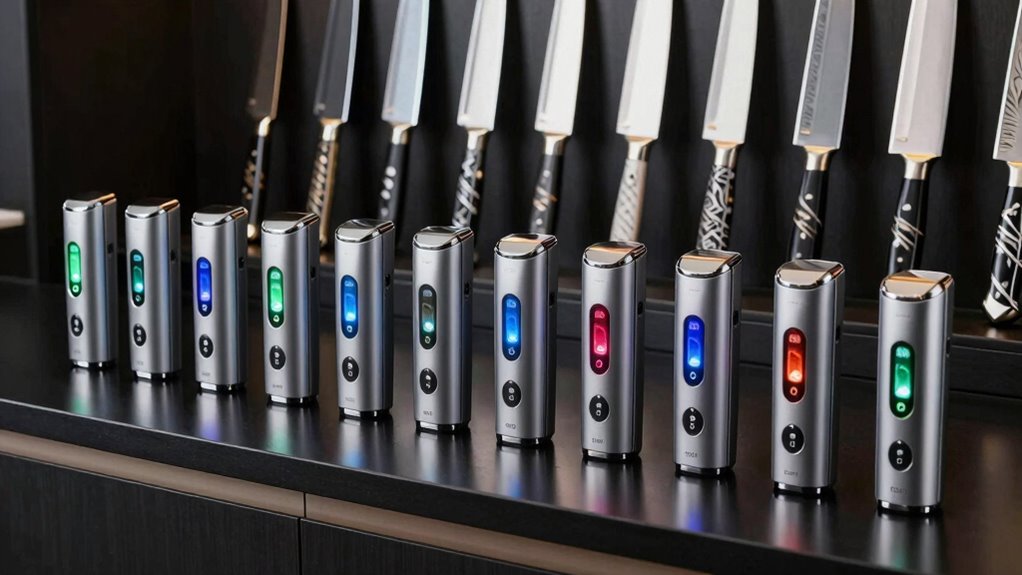
Japanese kitchen knives cut so well because their edges are ground to steep 10–15 degree angles — and most electric sharpeners are built for thicker 20-degree Western blades, which can ruin them. The Chef’sChoice 15XV EdgeSelect is the best overall pick here because it’s one of the few plug-in sharpeners engineered specifically for a true 15-degree Asian edge, with a dedicated stropping stage for polish. If you want more control over edge geometry, the Work Sharp Ken Onion Edition Mk.2 lets you adjust angles and even handle serrated or outdoor blades. For sharpening on a budget, the Presto 08810 EverSharp covers basic kitchen duties, though it removes more steel than finer systems. The main tradeoffs in this category come down to angle precision vs. speed, steel removal vs. edge polish, and simplicity vs. versatility. Keep reading for the full ranked breakdown of all fifteen models.

Get health and wellness essentials delivered free with Prime
- Fast, free delivery on millions of items
- Prime Video, Amazon Music and more included
- Member-only deals all year
Key Takeaways
- Only the Chef’sChoice 15XV family (picks 6 and 14) natively sharpens at a true 15-degree Asian angle — everything else in the lineup either runs at 20 degrees or offers manual angle control, which matters if your gyuto or santoku has a factory 12–15° edge.
- Work Sharp dominates the versatile end with three belt-based entries (picks 4, 10, and 12); they trade guided consistency for the ability to set custom angles and sharpen scissors, cleavers, and tools — the Mk.2 bundle with replacement belts (pick 12) is the better long-term buy.
- Several budget 3-stage units (picks 1, 11, and 15) share near-identical designs with different badges; they work for soft stainless steel but grind aggressively enough to shorten the life of hard, thin Japanese steel.
- Multi-function sharpeners like the 5-in-1 with three-speed diamond abrasives (pick 3) and the STONETIGER 4-in-1 (pick 15) are better suited to mixed knife drawers than to dedicated Japanese knife collections — versatility came at the cost of edge refinement.
- The two Presto models split by feature set rather than quality: the 08810 adds a third polishing stage over the 08800, making it the smarter pick if you own any Japanese blades at all.
| 3-Stage Electric Kitchen Knife Sharpener with 20° Angle Guide |  | Best Straightforward 3-Stage Pick | Sharpening stages: 3 | Abrasive: 100% diamond wheels | Sharpening angle: 20° preset | VIEW ON AMAZON | See Our Full Breakdown |
| Northmas QN-M868 Electric Knife Sharpener, 2-Stage, Blue |  | Best Compact Option | Brand: Northmas | Model: QN-M868 | Sharpening stages: 2 (sharpen and polish) | VIEW ON AMAZON | See Our Full Breakdown |
| 5-in-1 Electric Knife Sharpener with 3-Speed Diamond Abrasives |  | Best Angle-Adjustable Versatilist | System: 5-in-1, 3-stage sharpening | Speeds: 3 (Low, Medium, High) | Abrasives: 100% diamond | VIEW ON AMAZON | See Our Full Breakdown |
| Work Sharp Ken Onion Edition Mk.2 Knife & Tool Sharpener |  | Best Premium Belt System | Sharpening method: Flexible abrasive belts | Controls: Electronic speed control | Compatible items: Knives and tools | VIEW ON AMAZON | See Our Full Breakdown |
| Narcissus QN-M866 2-Stage Electric Knife Sharpener with Scissors Slot |  | Best Value for Multi-Task Households | Brand: Narcissus | Model: QN-M866 | Sharpening stages: 2 (coarse and fine) | VIEW ON AMAZON | See Our Full Breakdown |
| Chef’sChoice 15XV EdgeSelect 3-Stage Electric Knife Sharpener |  | Best Overall for Converting to True Japanese Angles | Type: Electric knife sharpener | Stages: 3 | Abrasive: 100% diamond abrasives in stages 1 and 2 | VIEW ON AMAZON | See Our Full Breakdown |
| Presto 08810 Professional EverSharp Electric Knife Sharpener |  | Best Value for Mixed Knife Drawers | Model: 08810 | Brand: Presto | Sharpening stages: 3 | VIEW ON AMAZON | See Our Full Breakdown |
| Work Sharp Electric Kitchen Knife Sharpener |  | Best Compact for Small Kitchens | Power type: Electric | Sharpener type: Fully guided electric knife sharpener | Operation: Push-button | VIEW ON AMAZON | See Our Full Breakdown |
| Chef’sChoice 3-Stage Electric Knife Sharpener with Diamond Abrasives |  | Best for Preserving Traditional 20-Degree Edges | Type: 3-stage electric knife sharpener | Abrasive: 100% diamond | Compatible knives: 20-degree class straight-edge and serrated knives | VIEW ON AMAZON | See Our Full Breakdown |
| Work Sharp MK2 Electric Knife Sharpener |  | Best Belt System for Knife-and-Tool Households | Brand: Work Sharp | Model: WSKTS2 | Type: Electric knife and tool sharpener | VIEW ON AMAZON | See Our Full Breakdown |
| Hrevzon 3-Stage Electric Knife Sharpener with Diamond Abrasives |  | Best Value for Diamond Abrasives | Stages: 3 (coarse, fine, polish) | Abrasive: Diamond sharpening wheels | Sharpening angle: 20° | VIEW ON AMAZON | See Our Full Breakdown |
| Work Sharp MK2 Electric Knife Sharpener with Replacement Belts |  | Best for Beyond-the-Kitchen Versatility | Motor: Two-speed | Compatible tools: Kitchen and pocket knives, serrated knives, scissors, axes, lawn mower blades, and garden tools | Included: Replacement belts | VIEW ON AMAZON | See Our Full Breakdown |
| Presto 08800 EverSharp Electric Knife Sharpener |  | Best No-Frills Starter Pick | Model: 08800 | Sharpening system: Two-stage | Compatible blades: Most non-serrated blades | VIEW ON AMAZON | See Our Full Breakdown |
| Chef’sChoice 15XV Professional 3-Stage Electric Knife Sharpener |  | Best Overall for Japanese-Style Edges | Stages: 3 | Abrasives: 100% diamond in stages 1 and 2; flexible abrasive stropping disks in stage 3 | Compatible knives: Straight-edge, serrated, and Asian-style knives | VIEW ON AMAZON | See Our Full Breakdown |
| STONETIGER 4-in-1 Electric Knife Sharpener |  | Best Stable Countertop Design | Motor speed: 6500 RPM | Sharpening system: 3-stage | Compatible tools: Straight-edge knives and household scissors | VIEW ON AMAZON | See Our Full Breakdown |
| electric knife sharpener for japanese knife | Warranty |
|---|---|
| 3-Stage Electric Kitchen Knife | 1-year replacement |
| Northmas QN-M868 Electric Knif | — |
| 5-in-1 Electric Knife Sharpene | — |
| Work Sharp Ken Onion Edition M | 3 years |
| Narcissus QN-M866 2-Stage Elec | — |
| Chef’sChoice 15XV EdgeSelect 3 | 3-year limited |
| Presto 08810 Professional Ever | — |
| Work Sharp Electric Kitchen Kn | 3 years |
| Chef’sChoice 3-Stage Electric | — |
| Work Sharp MK2 Electric Knife | 3 years |
| Hrevzon 3-Stage Electric Knife | — |
| Work Sharp MK2 Electric Knife | 3 years |
| Presto 08800 EverSharp Electri | — |
| Chef’sChoice 15XV Professional | Three-year limited |
| STONETIGER 4-in-1 Electric Kni | 18 months |
More Details on Our Top Picks
3-Stage Electric Kitchen Knife Sharpener with 20° Angle Guide
This sharpener stands out for simplicity: three diamond-wheel stages take a blade from repair to polish with a preset 20° angle guide, so there is no guesswork involved. That said, the fixed angle is the tradeoff for Japanese knife owners — many Japanese blades are ground closer to 15°, and reprofiling them at 20° works but sacrifices some of the factory-edge slicing performance that makes those knives special. Compared with the Chef’sChoice 15XV, which is built specifically around steeper Asian-style angles, this model is better treated as a general household workhorse. The magnetic shaving collector is a genuinely useful touch that the Presto EverSharp line lacks, keeping the counter clean between sessions.
Pros:- Three diamond stages handle repair, sharpening, and polishing in one unit
- Preset 20° guide produces consistent edges without practice
- Magnetic collector simplifies cleanup
- Simple pull-through design anyone can use
Cons:- Fixed 20° angle is steeper than most Japanese factory edges
- Cannot handle serrated blades
- Requires a 110V U.S. outlet, so it’s not travel-friendly
Best for: Home cooks who want a no-fuss 3-stage sharpener for everyday Western-style kitchen knives and don’t want to fuss with technique
Not ideal for: Enthusiasts with premium Japanese knives ground at 15°, since the fixed 20° angle will change the blade’s original geometry over time
- Sharpening stages:3
- Abrasive:100% diamond wheels
- Sharpening angle:20° preset
- Knife compatibility:Most non-serrated kitchen knives
- Metal shavings collection:Built-in magnetic collector
- Power supply:110V, U.S. standard
- Warranty:1-year replacement
Our verdict“A sensible pick for general kitchen sharpening, but Japanese knife purists will want an angle-adjustable alternative.”
Northmas QN-M868 Electric Knife Sharpener, 2-Stage, Blue
The Northmas QN-M868 wins on footprint and portability. Its two-stage system covers the two things most people actually do — sharpen and polish — and its 100-240V global voltage support means it works anywhere in the world, which no U.S.-only model in this roundup can claim. Where the Narcissus QN-M866 adds a scissors slot and the 3-Stage 20° model adds a repair stage, the Northmas keeps things lean, and that restraint is the point: less counter space, fewer slots to confuse beginners. The compromise is capacity rather than capability — very dull or chipped blades may need several passes, and there is no coarse repair wheel for real edge damage. For maintaining an already-decent edge on Japanese-style kitchen knives, it’s a clean, low-commitment choice.
Pros:- Genuinely compact body fits in a drawer
- 100-240V support for worldwide use
- Two-stage system produces a smooth, burr-free polish
- Stable operation without overheating
Cons:- Requires careful blade placement and technique for good results
- Multiple passes needed for very dull knives
Best for: Apartment cooks and travelers who need a small sharpener that maintains edges and works on international voltage
Not ideal for: Anyone restoring badly dull or damaged blades, since the two-stage system lacks a dedicated repair wheel
- Brand:Northmas
- Model:QN-M868
- Sharpening stages:2 (sharpen and polish)
- Voltage:100-240V global
- Color:Blue
- Included components:Adaptor, main body
Our verdict“The right choice if space and portability matter more than heavy-duty repair capability.”
5-in-1 Electric Knife Sharpener with 3-Speed Diamond Abrasives
This is the most feature-dense option in this batch, and the standout spec for Japanese knife owners is the adjustable angle guide from 20° up to 32.5° paired with three motor speeds — a level of control none of the fixed-angle pull-through models here offer. Being able to slow the wheel and choose a shallower setting matters when working with harder, thinner Japanese steel that punishes aggressive grinding. It also handles serrated blades, scissors, cleavers, and even axes, where the Northmas QN-M868 is limited to straight kitchen knives. The tradeoff is time and complexity: expect 3-5 passes per slot, and the LCD-and-speed interface means there’s more to learn before your first satisfying edge. It’s a tool for tinkerers, not for someone who wants five seconds of effort.
Pros:- Adjustable angle guide from 20° to 32.5° suits varied blade geometries
- 3-speed motor with LCD display gives real control over material removal
- Handles serrated knives, scissors, cleavers, ceramic blades, and axes
- Removable swarf collection plate and polishing bar for cleanup and refinement
Cons:- 3-5 passes per slot makes sharpening sessions slow
- More settings mean a steeper learning curve than basic two-stage models
Best for: Knife hobbyists who want speed and angle control for a mixed collection including Japanese blades, serrated knives, and workshop tools
Not ideal for: Impatient cooks who just want a quick pull-through sharpen before dinner — the multi-pass, multi-slot workflow takes real time
- System:5-in-1, 3-stage sharpening
- Speeds:3 (Low, Medium, High)
- Abrasives:100% diamond
- Angle guide:20° fixed, adjustable to 32.5°
- Display:LCD
- Compatible tools:Straight, serrated, cleaver, ceramic knives; scissors; axes
- Extras:Removable ceramic polishing bar, swarf collection plate
Our verdict“The pick for buyers who treat sharpening as a craft and want angle flexibility the fixed 20° models can’t provide.”
Work Sharp Ken Onion Edition Mk.2 Knife & Tool Sharpener
Unlike every wheel-based sharpener here, the Ken Onion Edition Mk.2 uses flexible abrasive belts, which conform to the blade and remove steel gently and evenly — a genuine advantage for Japanese knives, where hard steel and thin grinds are easily ruined by aggressive rigid wheels. The electronic speed control lets you slow down for delicate work, something the 5-in-1 model also offers but with a very different grinding mechanism. It sharpens far beyond the kitchen, covering outdoor and workshop tools, and carries a 3-year warranty that outclasses the 12-month policies on the Northmas and Narcissus units. The flip side: belts are consumables that wear out and need replacing, and the technique curve is real. This is closer to a guided freehand system than a brainless pull-through.
Pros:- Flexible belts are gentler on hard Japanese steel than rigid wheels
- Electronic speed control for delicate or heavy tasks
- Precision guides keep angles consistent across blade types
- 3-year warranty and Oregon-based calibration
Cons:- Abrasive belts wear out and must be repurchased
- Higher price point and a real learning curve compared with pull-through models
Best for: Serious knife owners willing to learn a belt technique and pay more for gentle, controllable sharpening of premium Japanese blades plus outdoor tools
Not ideal for: Buyers who want zero-skill push-button sharpening, since belt systems require practice and belts need periodic replacement
- Sharpening method:Flexible abrasive belts
- Controls:Electronic speed control
- Compatible items:Knives and tools
- Guides:Precision sharpening guides
- Designed and calibrated:Ashland, Oregon
- Warranty:3 years
Our verdict“The best choice for protecting expensive Japanese knives, provided you accept a consumable-belt system and some practice time.”
Narcissus QN-M866 2-Stage Electric Knife Sharpener with Scissors Slot
The Narcissus QN-M866 slots in as the budget-friendly all-rounder, combining coarse and fine stages with a dedicated scissors slot — a practical extra the Northmas QN-M868 doesn’t include. Its 30-watt motor is rated for over an hour of continuous operation, which is more sustained-duty headroom than most compact sharpeners advertise, making it a fit for households sharpening a whole knife block in one sitting. Like the Northmas, it accepts 100-240V, so it travels well. The limitations are familiar for this class: two stages mean no repair capability for damaged edges, and it’s specified for straight blades only, so it can’t match the 5-in-1 model’s serrated and cleaver coverage. The manufacturer also suggests watching the tutorial video first — a hint that technique matters here.
Pros:- Coarse and fine stages cover sharpening and polishing
- Bonus scissors sharpening slot adds everyday value
- 30W motor rated for over an hour of continuous use
- Magnetic collection box keeps mess contained
Cons:- Straight-blade knives only, with no stated support for serrated edges
- Instructional video recommended before first use, so it’s not fully intuitive out of the box
Best for: Budget-conscious households that want knife plus scissors sharpening and enough motor capacity for a full knife block in one session
Not ideal for: Owners of serrated or specialty blades, since compatibility is limited to straight-blade knives
- Brand:Narcissus
- Model:QN-M866
- Sharpening stages:2 (coarse and fine)
- Motor power:30 W
- Voltage:100–240 V
- Compatible blades:Straight-blade knives
- Additional function:Scissors sharpening slot
- Dust collection:Magnetic collection box
- Warranty and support:12-month replacement/refund; 24-month after-sales service
Our verdict“A practical value pick for straight-blade kitchens that also want to keep scissors sharp without a second gadget.”
Chef’sChoice 15XV EdgeSelect 3-Stage Electric Knife Sharpener
This pick stands out for being the only mainstream electric sharpener that actively converts 20-degree Western edges to a true 15-degree Trizor edge — the geometry Japanese knives actually use. The three-stage diamond abrasive system sharpens, hones, and then polishes, and once a blade is converted, resharpening takes about ten seconds. Compared with the Chef’sChoice 3-Stage (B000CSK0DM), which stays locked in the 20-degree class, the 15XV is the better match for anyone whose collection leans Japanese. The tradeoff is real, though: conversion removes a meaningful amount of steel the first time through, so it’s a commitment for knives you plan to keep for years.
Pros:- Converts 20-degree edges to a true 15-degree Japanese-style angle
- 100% diamond abrasives in the sharpening stages
- Handles both straight-edge and serrated blades
- Resharpening takes roughly 10 seconds once the edge is established
- Flexible guides keep the angle consistent without guesswork
Cons:- Initial conversion removes significant blade material
- Requires an outlet, so it’s not portable or usable off-grid
Best for: Owners of hybrid or Western-Japanese knife collections who want a lasting 15-degree edge without learning freehand sharpening
Not ideal for: Collectors of expensive single-bevel traditional Japanese knives — aggressive powered conversion can damage delicate edges better left to whetstones
- Type:Electric knife sharpener
- Stages:3
- Abrasive:100% diamond abrasives in stages 1 and 2
- Compatible blades:Straight-edge and serrated knives
- Sharpening angle:15 degrees (converts from 20 degrees)
- Dimensions:10 × 4.25 × 4.25 inches
- Warranty:3-year limited
Our verdict“This model makes the most sense for cooks ready to permanently commit their knives to a sharper 15-degree Japanese-style edge.”
Presto 08810 Professional EverSharp Electric Knife Sharpener
The EverSharp earns its spot through one feature most rivals skip: a blade thickness selector that adjusts the sharpening geometry for thick hunting blades, standard chef’s knives, or thin fillet and paring knives. That flexibility matters if your drawer mixes Santokus with sporting knives — something the Work Sharp Electric Kitchen Knife Sharpener, with its kitchen-first focus, handles less gracefully. The three-stage system ends in an extra-fine ceramic wheel that leaves a respectable polished edge. Compared with the Presto 08800, this version adds the thickness selector and better finishing. The honest downside: the aggressive powered stages can strip more metal than a whetstone would, so thin Japanese blades lose lifespan faster than they should.
Pros:- Blade thickness selector tunes the angle to the knife type
- Works on kitchen, sport, and Santoku knives
- Guided slots hold the blade at the correct angle
- Extra-fine ceramic finishing wheel hones to a sharp edge
Cons:- Removes more blade material than manual or stone sharpening
- No true 15-degree Japanese angle option
Best for: Budget-minded households with a mix of kitchen, Santoku, and sport knives who want adjustable sharpening in one unit
Not ideal for: Owners of thin, high-hardness Japanese knives — the material removal rate shortens blade life and can over-grind delicate edges
- Model:08810
- Brand:Presto
- Sharpening stages:3
- Blade thickness selector:Thick (hunting), Medium (chef’s/kitchen), Thin (fillet/paring)
- Finishing wheel:Extra-fine-grit ceramic
- Power:Electric
- Compatible knives:Kitchen, sport, and Santoku knives
Our verdict“A sensible budget pick for versatile households, but not the gentlest choice for premium Japanese steel.”
Work Sharp Electric Kitchen Knife Sharpener
This model is better suited to apartment cooks who want a drawer-storable sharpener that still delivers guided, consistent edges. The fully guided push-button system removes the skill factor entirely, and the built-in ceramic hone wheel lets you touch up edges weekly rather than regrinding them — a gentler routine for Japanese-style kitchen knives than the Presto 08810’s more aggressive approach. Unlike the Work Sharp MK2, which is a belt-based multi-tool powerhouse, this unit stays kitchen-focused, sharpening knives, serrated edges, scissors, and shears. That focus is also its limit: there’s no angle adjustability, so you get the edge geometry the factory sets and nothing else.
Pros:- Compact design fits in a kitchen drawer
- Fully guided system produces even, repeatable edges
- Built-in ceramic hone wheel for frequent maintenance
- Also handles serrated edges, scissors, and shears
- 3-year warranty
Cons:- No adjustable sharpening angle
- Requires counter or drawer space and an outlet
- Kitchen-focused — limited for outdoor or workshop tools
Best for: Small-kitchen cooks and apartment dwellers who want guided sharpening plus routine honing in a compact, storable unit
Not ideal for: Users who want to control or convert edge angles — the fixed geometry won’t produce a custom 15-degree Japanese profile
- Power type:Electric
- Sharpener type:Fully guided electric knife sharpener
- Operation:Push-button
- Compatible items:Kitchen knives, serrated edges, scissors, shears
- Abrasive type:Premium abrasives with ceramic hone wheel
- Warranty:3 years
- Design location:Ashland, Oregon, USA
Our verdict“The pick for space-constrained cooks who value consistency and easy maintenance over angle control.”
Chef’sChoice 3-Stage Electric Knife Sharpener with Diamond Abrasives
Think of this as the conservative sibling of the Chef’sChoice 15XV: same three-stage diamond architecture, but it keeps knives in the 20-degree class rather than converting them. That’s a genuine advantage for owners of German-style knives or Japanese knives with more forgiving edges — no aggressive regrinding, no irreversible geometry change. The standout trick is the choice between a micro-serrated or polished finish, which the 15XV doesn’t offer; the micro-serrated option bites harder into slippery foods like tomatoes. The tradeoff is obvious for this roundup’s lens: if your goal is a true Japanese 15-degree edge, this model simply can’t deliver it.
Pros:- Choose between micro-serrated and polished edge finishes
- 100% diamond abrasives for sharpening and honing
- Precision angle guides for consistent results
- Handles both straight-edge and serrated knives
Cons:- Limited to 20-degree class knives
- Fixed geometry with no conversion path
Best for: Cooks with mostly Western or hybrid 20-degree knives who want edge-finish flexibility without regrinding their blades
Not ideal for: Buyers specifically chasing a 15-degree Japanese edge — this sharpener is locked to 20-degree geometry
- Type:3-stage electric knife sharpener
- Abrasive:100% diamond
- Compatible knives:20-degree class straight-edge and serrated knives
- Angle control:Precision angle guides
- Finish options:Micro-serrated or polished
- Color:Silver
Our verdict“A solid, no-drama sharpener for 20-degree knives, but the wrong tool if authentic Japanese angles are the goal.”
Work Sharp MK2 Electric Knife Sharpener
The MK2 takes a different approach from every slot-based model here: flexible abrasive belts driven by a two-speed motor that conform to the blade’s curve instead of grinding a fixed angle into it. That belt design is gentler per pass than the Presto EverSharp’s wheels and reaches all the way to the tip thanks to the edge guide. It’s also the most capable all-rounder in this batch — kitchen knives, pocket knives, serrations, scissors, axes, and garden tools — compared with the kitchen-only Work Sharp Electric Kitchen model. The catch for Japanese-knife purists: belts are consumables that wear, clog, and need replacing, and the freehand-adjacent technique demands a lighter touch than a fully guided slot system.
Pros:- Flexible belts conform to curved blade edges and tips
- Two-speed motor offers control for light or heavy jobs
- Handles knives, serrations, scissors, axes, and garden tools
- 3-year warranty
Cons:- Abrasive belts are consumables that need replacing
- More technique-dependent than fully guided slot sharpeners
Best for: Households that sharpen everything from Japanese kitchen knives to axes and garden tools and don’t mind maintaining belts
Not ideal for: Set-and-forget users — belts wear out, require replacement stock, and demand more technique than guided slot sharpeners
- Brand:Work Sharp
- Model:WSKTS2
- Type:Electric knife and tool sharpener
- Motor:Two speed
- Abrasives:Flexible abrasive belts
- Included components:Abrasive belts, knife sharpener
- Warranty:3 years
- Designed and calibrated:Ashland, Oregon
Our verdict“The most versatile sharpening platform here, best for tool-heavy households willing to manage belts and technique.”
Hrevzon 3-Stage Electric Knife Sharpener with Diamond Abrasives
Diamond wheels at a budget-friendly tier are what set this Hrevzon apart from most three-stage sharpeners in this roundup, where synthetic stones are the norm. The coarse, fine, and polish sequence covers the full sharpening journey — something the two-stage Presto EverSharp handles with fewer steps but less refinement on the final edge. The built-in magnetic dust collector is a genuinely useful touch that even some pricier models in this guide lack, keeping metal shavings off the countertop. The fixed 20° angle is the main compromise for Japanese knife owners: it works, but it’s steeper than the 15° edge the Chef’sChoice 15XV creates, which is closer to a traditional Japanese blade geometry. Expect to make several passes per slot for dull blades.
Pros:- Diamond wheels sharpen faster and more evenly than standard synthetic stones
- Three-stage system includes a dedicated polishing slot
- Magnetic dust collector keeps cleanup contained
- Four silicone pads anchor the unit during use
Cons:- Only compatible with straight-edge knives — no serrated blade support
- Requires multiple passes through each slot to fully restore dull edges
Best for: Home cooks with mixed Western-style kitchen knives who want a full sharpening-and-polishing system without paying premium-brand prices
Not ideal for: Owners of true Japanese knives with acute 15° edges — the fixed 20° angle will gradually reprofile the blade
- Stages:3 (coarse, fine, polish)
- Abrasive:Diamond sharpening wheels
- Sharpening angle:20°
- Compatible knives:Straight-edge chef, paring, and boning knives
- Base:4 non-slip silicone pads
- Dust collection:Built-in magnetic collector
- Color:Black/orange
Our verdict“A sensible middle-ground pick if you want diamond abrasives and three-stage flexibility but don’t need serrated-knife capability.”
Work Sharp MK2 Electric Knife Sharpener with Replacement Belts
Where every other sharpener here is a kitchen-drawer specialist, the Work Sharp MK2 is a workshop tool that happens to handle kitchen knives well. Its flexible belts conform to the blade edge, which produces a convex edge that many cooks find slices better than the flat bevel you get from fixed-slot units like the Hrevzon or Presto EverSharp. The two-speed motor lets you slow down for fragile thin blades and speed up for axes and mower blades — a level of control no single-speed kitchen model offers. The included replacement belts add long-term value, and the 3-year warranty backs a genuinely durable build. The tradeoff: belts are consumables, and freehand-ish belt sharpening has a learning curve compared to fully guided slots.
Pros:- Handles an unusually wide range of blades and tools beyond kitchen knives
- Two-speed motor gives control for both fine sharpening and heavy grinding
- Edge guide supports the blade all the way to the tip
- Includes replacement belts and a 3-year warranty
Cons:- Abrasive belts wear out and need periodic replacement
- Requires more technique and practice than fixed-slot electric sharpeners
Best for: Hands-on owners who want one sharpener for kitchen knives, pocket knives, scissors, axes, and garden tools
Not ideal for: Buyers who want zero-technique, drop-the-blade-in-a-slot simplicity — belts demand more practice than guided wheels
- Motor:Two-speed
- Compatible tools:Kitchen and pocket knives, serrated knives, scissors, axes, lawn mower blades, and garden tools
- Included:Replacement belts
- Warranty:3 years
- Designed and calibrated:Ashland, Oregon
Our verdict“The pick for versatile sharpeners who’d rather own one capable tool than a drawer full of single-purpose machines.”
Presto 08800 EverSharp Electric Knife Sharpener
This is the sharpener for someone who has never sharpened anything and doesn’t want to think about angles, stages, or technique. The precision blade guides do the alignment work for you — just pull the knife through and the Sapphirite wheels produce a working edge in a few passes. Compared with the Chef’sChoice 15XV, the Presto EverSharp skips the third polishing stage and the 15° Asian-edge conversion, so the finished edge is serviceable rather than razor-refined. That simplicity is exactly the point: it’s the lowest-friction entry into electric sharpening in this roundup. Two real limits stand out — no serrated blade support, and the 120 V North American power design makes it a poor travel companion for international kitchens.
Pros:- Two-stage grind-and-hone system produces a sharp edge quickly
- Precision guides hold the blade angle so no skill is required
- Handles most non-serrated kitchen and sport knives
Cons:- No serrated blade support at all
- Only two stages — no polishing step for a refined edge
- Locked to 120 V North American electrical standards
Best for: First-time sharpening novices with basic Western kitchen knives who want the simplest possible pull-through experience
Not ideal for: Serrated knife owners or anyone outside North America on 220–240 V power
- Model:08800
- Sharpening system:Two-stage
- Compatible blades:Most non-serrated blades
- Sharpening wheels:Sapphirite
- Voltage:120 V
- Electrical standards:North American
Our verdict“Buy it if you want foolproof sharpening on a basic knife set; skip it if you own serrated blades or live abroad.”
Chef’sChoice 15XV Professional 3-Stage Electric Knife Sharpener
For the specific question this roundup asks — sharpening Japanese knives — the Chef’sChoice 15XV is the strongest answer. Its defining feature is the 15-degree Trizor XV edge, which converts traditional 20-degree Western edges into the acute geometry Japanese blades are ground to, something no other sharpener in this lineup does. Full diamond abrasives in the first two stages, plus a flexible stropping stage that also handles serrated knives, give it the most complete edge-care toolkit here. Compared with the Hrevzon’s fixed 20° slots, the sharper 15° bevel slices tomato skin noticeably more cleanly. Resharpening takes about 10 seconds thanks to the spring-loaded guides. The compromises are noise (65–75 dB, louder than pull-through rivals) and roughly a minute of grinding for the initial edge conversion.
Pros:- Converts 20° Western edges to sharper 15° Japanese-style Trizor edges
- Handles straight-edge, Asian-style, and serrated knives
- Spring guides automatically align the blade at the correct angle
- Resharpening takes roughly 10 seconds
Cons:- Runs at 65–75 dB — noticeably louder than most competitors
- First-time edge conversion takes about a minute per knife
Best for: Serious home cooks and knife enthusiasts who want true Japanese-style 15° edges plus serrated blade capability in one machine
Not ideal for: Quiet-kitchen households or casual users who’d find a one-minute initial sharpening and a loud motor off-putting
- Stages:3
- Abrasives:100% diamond in stages 1 and 2; flexible abrasive stropping disks in stage 3
- Compatible knives:Straight-edge, serrated, and Asian-style knives
- Edge angle:15 degrees
- Sharpening time:~1 minute first sharpening; ~10 seconds resharpening
- Noise level:65–75 dB
- Dimensions:6.2 × 12 × 6.4 inches
- Warranty:Three-year limited
Our verdict“If authentic Japanese knife geometry is the goal, this is the sharpener the rest of this list is measured against.”
STONETIGER 4-in-1 Electric Knife Sharpener
The STONETIGER‘s claim to attention is stability: a suction-cup base that anchors the unit to the counter more firmly than the silicone pads on the Hrevzon, which matters when you’re pressing a knife through a 6500 RPM wheel. Combined with the magnetic dust collection box, it’s one of the cleaner-operating models here. The three-stage system plus a scissors slot gives it more functionality than the Presto EverSharp’s two slots, and the manufacturer’s roughly 20-second sharpening claim is competitive with anything in this guide. Its 100–240 V compatibility also beats the Presto for international use. The downsides: straight-edge knives and household scissors only — no serrated support — and the manual-first recommendation hints that correct slot usage isn’t entirely intuitive.
Pros:- Suction-cup base keeps the unit rigidly stable during sharpening
- Magnetic collection box contains metal dust
- Adds a household scissors slot beyond the three knife stages
- 100–240 V power works worldwide
Cons:- Limited compatibility — straight-edge knives and scissors only
- Manual reading recommended before first use, suggesting a learning curve
Best for: Renters and frequent movers, or international buyers, who want a firmly anchored sharpener with dual-voltage power and scissors capability
Not ideal for: Serrated knife owners, or anyone impatient with reading instructions before first use
- Motor speed:6500 RPM
- Sharpening system:3-stage
- Compatible tools:Straight-edge knives and household scissors
- Voltage:100–240 V
- Sharpening time:About 20 seconds
- Dust collection:Magnetic collection box
- Base:Suction-cup base
- Warranty:18 months
Our verdict“A good fit for stability-minded and internationally mobile buyers who mainly sharpen straight-edge blades.”

How We Picked
Because Japanese knives are thinner and harder than Western blades, I weighted each sharpener on four factors, in this order. First, angle support: a system that can produce or preserve a 15-degree edge scored highest, since a 20-degree pull-through grind permanently thickens a Japanese blade’s performance. Second, abrasive gentleness and edge refinement — diamond abrasives, stropping stages, and adjustable belts earn credit for leaving a polished, durable edge instead of a rough micro-serrated one that dulls fast. Third, steel removal rate, because over-grinding is the single fastest way to kill a laminated or high-hardness knife. Fourth, ease of use and consistency, since most buyers of electric sharpeners want repeatable results without freehand skills.
Versatility, build quality, and long-term running costs (replacement belts, abrasive wear) acted as tiebreakers, which is why the Work Sharp Mk.2 with replacement belts ranks above the identical bare unit. Price never determined placement on its own — several cheaper models outperformed pricier ones for Japanese steel specifically, while some premium-feeling multi-function units lost points for grinding too coarsely. The ranking reflects which sharpener a Japanese knife owner should buy first, not which is best in the abstract.
Factors to Consider When Choosing Electric Knife Sharpener For Japanese Knives
Before picking from the fifteen models above, it helps to understand what actually separates a sharpener that flatters Japanese steel from one that quietly damages it. These are the factors I’d weigh first.Edge Angle Compatibility
The single most consequential spec is the angle the sharpener grinds at. Japanese knives typically ship with 10–15 degree per-side edges, while most affordable electric sharpeners are fixed at 20 degrees. Running a santoku through a 20-degree slot doesn’t just give you a worse edge — it removes the thin geometry that makes the knife worth owning, and restoring it later requires professional regrinding. Look for either a dedicated 15-degree machine or a belt system with adjustable angle guides. A common mistake is assuming a ‘sharpens all knives’ label means it sharpens all knives well; nearly every model in this roundup claims universal compatibility, but only a handful actually preserve Asian geometry. If you own a mix of German and Japanese knives, a two-angle machine or adjustable system earns its price premium immediately.
Abrasive Type and Stage Count
More stages only help when each stage has a purpose. A good progression runs coarse (repair) → medium (shape) → fine/strop (polish), and the polish stage is what separates a sharpener that leaves a toothy, quick-dulling edge from one that produces a refined edge that holds. Diamond abrasives matter more than stage count for Japanese steel, because hardness in the HRC 60+ range laughs at cheap alumina wheels. The stropping stage on the Chef’sChoice machines and the fine belts on Work Sharp units serve the same purpose differently: wheels are guided and foolproof, belts are more forgiving of pressure mistakes. Skip machines whose extra slots are marketing filler — the 4-in-1 and 5-in-1 units in this roundup demonstrate that added scissors and cleaver slots don’t improve kitchen-knife outcomes.
Steel Removal Rate and Blade Longevity
Every pass through an electric sharpener removes metal you can never put back, and inexpensive pull-through units remove a lot of it — often in uneven amounts. If you sharpen monthly, an aggressive sharpener can visibly change a blade profile within a couple of years. Thinner, harder Japanese steel is less forgiving of this than soft Western stainless: uneven grinding shows up faster, and chipping at the edge is a real risk with coarse wheels and heavy hand pressure. Belt systems let you control pressure manually, which is gentler if you’re attentive but worse if you’re heavy-handed. The practical rule: match the sharpener’s aggressiveness to how often you’ll actually use it. A coarse fast machine for a dull knife twice a year does less harm than a coarse machine used weekly out of habit.
Guided Consistency vs. Manual Control
This is the real fork in the road. Fixed-slot sharpeners (Chef’sChoice, Presto, Narcissus, and the budget 3-stage clones) hold the angle for you — results are consistent, learning curve is minutes, but you’re locked into their geometry. Belt sharpeners (the three Work Sharp entries) let you choose your angle and pressure, which is the only way to match a factory 12-degree edge or put a convex grind on a blade — but poor technique produces poor edges, and belts wear out and need replacing. Beginners almost always get better immediate results from guided slots. Enthusiasts who own multiple Japanese knives and enjoy the process will outgrow fixed slots within a year. Neither approach is wrong; the mistake is buying the enthusiast tool when you wanted convenience, or vice versa.
Build Quality and Long-Term Costs
Motor quality shows up in two ways: how the machine handles blade pressure without bogging down, and how long the abrasives last before the unit starts polishing rather than sharpening. The cheapest units in this comparison share thin plastic housings and motors that slow under load, which causes uneven edges because one side of the blade gets ground more than the other. Abrasive replacement is the hidden cost — Work Sharp belts are consumables by design (one entry here bundles replacements for that reason), while diamond-wheel machines like the Chef’sChoice units last far longer but cost more upfront. Check whether the abrasive stage is user-replaceable at all; a sealed unit that wears out is e-waste. For a knife collection worth hundreds of dollars, spending more on the sharpener is cheap insurance.
Frequently Asked Questions
Will a standard 20-degree electric sharpener ruin my Japanese knives?
It won’t destroy them in one session, but it will degrade what makes them special. A 20-degree grind is thicker than the 10–15 degree edge your knife was designed for, so the knife will still cut but with noticeably more resistance, and the performance loss is cumulative with each sharpening. The bigger risk is that restoring the original thin geometry later requires a professional regrind that removes even more steel. If a 15-degree machine like the Chef’sChoice 15XV is out of budget, an adjustable belt system like a Work Sharp lets you match the factory angle. The one scenario where 20 degrees is defensible: a cheap soft-stainless ‘Japanese-style’ knife that doesn’t actually have a true Asian edge to begin with.
Are belt sharpeners like the Work Sharp better than pull-through slot sharpeners for Japanese steel?
Neither is universally better — they solve different problems. Slot sharpeners hold a fixed angle with zero skill required, which is why they produce more consistent results for most people. Belt sharpeners trade that consistency for control: you can set a 12-degree edge, adjust pressure, sharpen a wide gyuto without scratching the blade face, and handle everything from paring knives to cleavers. The catch is that belts wear, technique matters, and one distracted pass can round over an edge you just built. If you own two or three Japanese knives and want them reliably sharp, a good fixed-angle machine wins. If you own many knives, enjoy the process, and want to preserve custom geometry, the belt route pays off.
How often should I sharpen Japanese knives on an electric sharpener?
Far less often than most people assume — over-sharpening removes more steel than dullness ever will. A quality Japanese knife holds its edge for one to three months of home use, and between full sharpenings you should maintain it with a honing rod or leather strop weekly. Only run a knife through the coarse stage when the edge is actually damaged or visibly blunt; for routine touch-ups, the fine or stropping stage alone is enough. Electric sharpeners make it so easy to sharpen that many owners do it monthly out of habit, which is how thin blades get eaten away. Watch for the telltale sign: if the coarse stage barely seems to change anything, you didn’t need it.
Do I need a sharpener with a dedicated stropping or polishing stage?
For Japanese knives specifically, yes — it’s arguably the most important stage, not a luxury. A coarse or medium grind leaves a micro-serrated edge that feels sharp out of the machine but folds over and dulls within days on hard steel. The stropping stage polishes away those micro-burrs and leaves a refined edge that lasts weeks longer. That’s a key reason the Chef’sChoice 15XV outranks cheaper three-stage machines that promise similar slot counts without a true polish stage. If your chosen sharpener lacks one, you can approximate it with a few trailing strokes on a leather strop or even newspaper after sharpening — it takes thirty seconds and meaningfully extends edge life.
Are the budget 3-stage sharpeners under $30 good enough, or should I spend more?
Honestly, it depends on what knives you’re feeding them. For soft stainless steel with a 20-degree Western edge, the budget 3-stage units do a serviceable job — the designs in this roundup are near-identical clones of each other, and they’ll make a dull knife sharp again. The problem is their coarse wheels and imprecise angle guides, which remove steel quickly and unevenly, exactly the wrong behavior for hard, thin Japanese blades. Spending more buys you a true 15-degree geometry, gentler diamond abrasives, and a motor that doesn’t bog down mid-pass. My practical suggestion: if your knife cost under $60, a budget sharpener is a reasonable match; if you spent $150+ on Japanese steel, a cheap sharpener is the most expensive way to save money.
Conclusion
After comparing all fifteen models, the right choice comes down to what’s in your knife drawer and how much control you want. For best overall, the Chef’sChoice 15XV EdgeSelect stands alone as the plug-in machine actually built for 15-degree Asian edges, with diamond abrasives and a stropping stage that treats Japanese steel the way it deserves. The Chef’sChoice 3-Stage with Diamond Abrasives is a close runner-up if you can find it more readily.
For best value, the Presto 08810 EverSharp delivers a legitimate three-stage process at a modest price, and beats its own cheaper sibling (the 08800) thanks to the polishing stage that Japanese blades need. For best premium, the Work Sharp Ken Onion Edition Mk.2 is the enthusiast’s machine — adjustable angles, custom edge geometry, and the versatility to handle far more than kitchen knives, at the cost of a learning curve. Best for beginners goes to the Work Sharp Electric Kitchen Knife Sharpener, which keeps the brand’s belt system but adds guided angle simplicity.
For specific needs: the Work Sharp MK2 with replacement belts is the smart buy for anyone who already knows they’ll sharpen often and wants consumables covered; the 5-in-1 multi-function unit suits households with scissors, cleavers, and mixed knife brands; and the Narcissus QN-M866 is a fine compact pick for small kitchens with a soft-steel knife collection. If your knives are genuinely Japanese — hard, thin, and precise — start with the 15XV and don’t look back. If your drawer is a mix of everything, the versatile Work Sharp line will frustrate you least over time.
Columbus Day / Indigenous Peoples' Day Picks
long weekend sales
As an affiliate, we earn on qualifying purchases.