TL;DR

Get health and wellness essentials delivered free with Prime
- Fast, free delivery on millions of items
- Prime Video, Amazon Music and more included
- Member-only deals all year
A Stanford Medicine-led study found that resting-state brain activity patterns in adults aged 55 to 70 without cognitive impairment were associated with cognitive decline, amyloid-beta plaques and Alzheimer’s diagnoses over the following 12 years. The researchers say the scoring method is a potential early risk marker, not a proven diagnostic test or a way to prevent disease.
A Stanford Medicine-led study found that patterns of resting brain activity in adults with no apparent cognitive impairment were associated with their risk of later cognitive decline and Alzheimer’s disease. Published Nov. 4 in Science Advances, the research suggests these patterns may provide an early risk marker, years before memory loss or detectable Alzheimer’s-related changes in some participants, but it does not show that the scans can diagnose or prevent the disease.
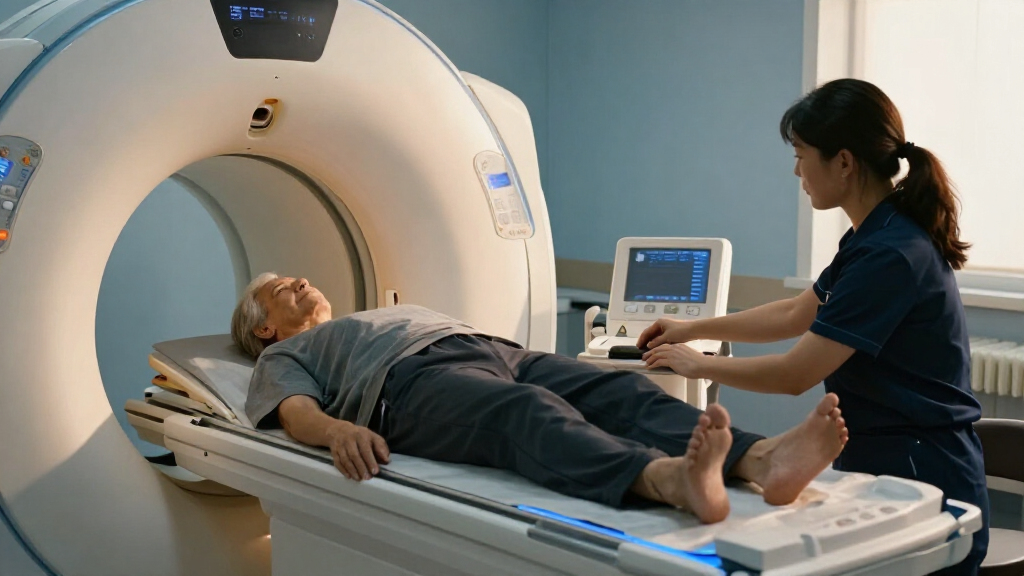
The researchers first compared resting-state functional MRI scans from 180 adults aged 75 or older who met the study’s definition of super agers with scans from 110 people diagnosed with Alzheimer’s. Super agers were defined as people with memory performance typical of a 45-year-old and executive function normal for their age. Resting-state fMRI records brain activity while a person lies still in a scanner.
The team identified differences in activity and connectivity across brain regions and used them to create a measure called the Alzheimer’s resilience-vulnerability connectome, or ARC score. It distinguished the two older groups with roughly 85% accuracy. The researchers then applied the score to more than 1,300 cognitively unimpaired adults aged 55 to 70, whose results fell across a range between the two patterns.
In the younger group, more Alzheimer’s-like scores were associated with a greater likelihood of later cognitive decline, amyloid-beta plaque development and an Alzheimer’s diagnosis within 12 years. More super-ager-like scores were associated with a greater likelihood of avoiding those outcomes. The report says the score predicted decline better than demographics, amyloid-beta and tau biomarkers, and genetics; it does not provide enough detail here to quantify that difference or establish how the tool would perform in routine clinical use.
A Possible Earlier Risk Signal
Alzheimer’s-related changes can be underway before a person or family notices memory problems. A marker associated with later outcomes in people who still perform normally on cognitive tests could help researchers identify earlier stages of risk and design studies that follow people before symptoms appear. The study’s comparison with established biomarkers is relevant because, according to senior author Yu Zhang, amyloid-beta and tau are often observed at later stages.
The findings may also point researchers toward brain activity patterns linked with resilience, rather than focusing only on signs of disease. Zhang said the longer-term hope is to learn whether interventions such as cognitive training or transcranial magnetic stimulation could alter those patterns. That remains a research possibility, not a treatment supported by this study: the interventions have not been tested here for cognitive decline, and researchers do not know whether changing a pattern would alter a person’s disease course.
Products Worth Considering

Fitbit Versa 2 Health and Fitness Smartwatch with Heart Rate, Alexa, Music, Sleep and Swim Tracking

Oral-B iO Series 3 Rechargeable Electric Toothbrush for Adults, Black, 3 Modes, 2 Brush Heads and Travel Case

Fitbit Inspire 3 Health and Fitness Tracker Bundle
As an affiliate, we earn on qualifying purchases.
How Researchers Built the ARC Score
The study addressed a challenge in defining resilience: people who appear cognitively normal are not necessarily alike biologically. Some may have early brain changes while others may show features associated with preserved cognition. Zhang told News-Medical that comparing super agers with a broad group of cognitively unimpaired people could obscure which brain patterns distinguish resilience from vulnerability.
Instead, the team began with two more clearly defined groups at opposite ends of the cognitive spectrum, then applied the resulting score to a younger, unimpaired cohort. The imaging data came from several research projects, including the Open Access Series of Imaging Studies, the Harvard Aging Brain Study and the Alzheimer’s Disease Neuroimaging Initiative. The approach produced a spectrum of scores rather than a simple division into “healthy” and “at risk.”
“What we really care about is defining early markers that can detect earlier signs of cognitive decline and potentially help us deliver timely interventions to people.”
— Yu Zhang, assistant professor of psychiatry and behavioral sciences at Stanford and the study’s senior author, as quoted by News-Medical
Limits of Risk Prediction
The report does not establish that an individual ARC score can predict with certainty whether a person will develop Alzheimer’s, nor does it describe the score as a validated clinical screening test. The reported roughly 85% accuracy applies to distinguishing the two older groups; it should not be read as 85% accuracy for predicting disease in the younger cohort. The source does not provide the younger group’s event rates, confidence intervals or detailed performance measures.
It is also unclear how well the findings would generalize to people outside the study samples, how the score compares with other risk models in clinical settings, or whether it can be used to guide care. The study found associations between patterns and later outcomes; it does not establish that the patterns cause decline. Researchers have not shown that modifying brain activity changes Alzheimer’s risk or disease progression.
Testing the Signal in Future Studies
The next steps are to test whether the ARC score predicts outcomes reliably in other groups and whether it adds useful information to existing assessments. Researchers would also need to establish how consistently the measure can be obtained and what score ranges, if any, should prompt further evaluation. The source report does not identify a clinical rollout or a timetable for one.
Zhang said the longer-term research aim is to determine which brain regions might be targeted and how activity could be changed. Before interventions such as cognitive training or transcranial magnetic stimulation can be considered for Alzheimer’s risk, studies would need to test whether they alter the relevant patterns and whether any change affects cognitive or clinical outcomes. For now, the ARC score is a research finding, not a basis for individual medical decisions.
Key Questions
What did the brain scans measure?
The researchers used resting-state functional MRI, which measures patterns of brain activity and connectivity while participants lie still in a scanner.
Does the ARC score diagnose Alzheimer’s?
No. The study reports an association between scores and later outcomes in a research cohort. It does not establish the ARC score as a diagnostic test or show that it can determine whether a particular person will develop Alzheimer’s.
What does the reported 85% accuracy mean?
The score distinguished the study’s older super-ager and Alzheimer’s groups with roughly 85% accuracy. That figure does not describe prediction accuracy for the younger, cognitively unimpaired group.
Can changing brain activity lower Alzheimer’s risk?
The study did not test that. Zhang mentioned cognitive training and transcranial magnetic stimulation as possible subjects for future research, but whether changing brain patterns can alter disease outcomes remains unknown.
Source: news-medical.net