TL;DR

Get health and wellness essentials delivered free with Prime
- Fast, free delivery on millions of items
- Prime Video, Amazon Music and more included
- Member-only deals all year
NATIVE-ID, a multi-institutional research project led by the Innovative Genomics Institute at UC Berkeley, aims to help AI predict when disordered proteins may begin harmful aggregation. The Stowers Institute’s Randal Halfmann lab will receive about $4.1 million over two years to study 50,000 proteins in yeast, generating data for a wider project funded at up to $28.6 million. The effort will initially focus on frontotemporal lobar degeneration; its predictions and any clinical benefits remain to be demonstrated.
A new multi-institutional research project will gather large-scale data on when proteins begin to aggregate, with the goal of training artificial intelligence to predict early dysfunction linked to neurodegenerative diseases. The Stowers Institute for Medical Research said Randal Halfmann’s laboratory will receive about $4.1 million over two years from the Advanced Research Projects Agency for Health (ARPA-H) to measure aggregation in 50,000 proteins as part of the broader NATIVE-ID project, funded at up to $28.6 million.
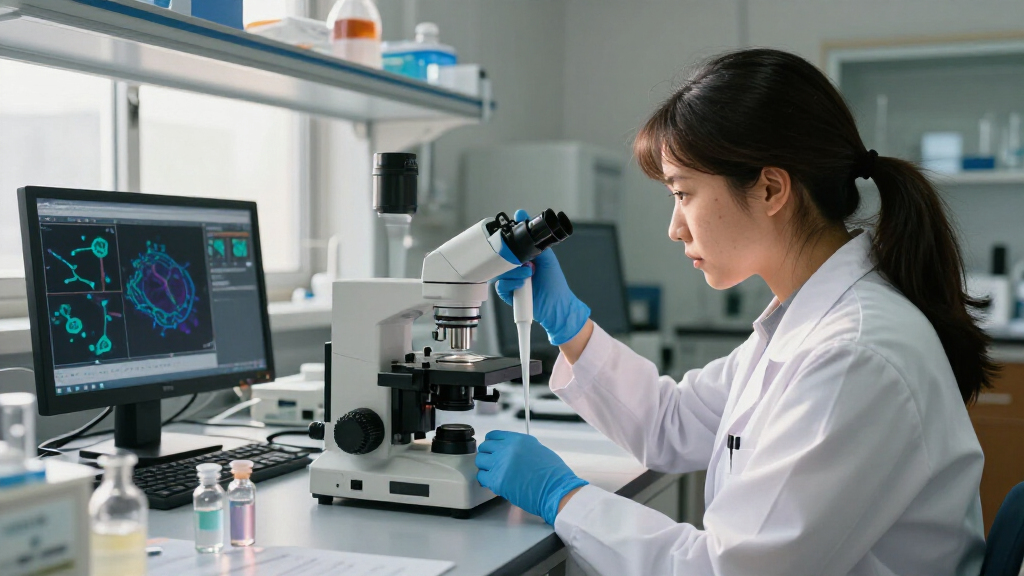
Halfmann’s team plans to express 50,000 proteins in yeast cells and test how changes in their amino-acid sequences affect whether they remain dispersed or form clumps. The experiments will use different conditions intended to mimic cellular changes associated with aging. The lab expects to examine more than one million samples and produce more than 10 billion measurements of aggregation.
The work will use Distributed Amphifluoric FRET, or DAmFRET, a method developed by Halfmann’s team in 2018 to measure protein self-assembly in individual living cells. The resulting data are intended to help train AI models to interpret intrinsically disordered proteins, which can adopt multiple shapes rather than maintaining one stable structure.
NATIVE-ID is led by the Innovative Genomics Institute at the University of California, Berkeley and is part of ARPA-H’s BIOGAMI program. The collaboration also includes researchers from Brown University, Emory University, Johns Hopkins University, Parallel Squared Technology Institute and Texas A&M University. The project will initially focus on frontotemporal lobar degeneration (FTLD), which shares genetic and biological features with ALS.
Building Data to Predict Protein Failure
The project addresses a limitation in current protein-prediction methods. AI has advanced the prediction of structures for many proteins, but the source report says roughly one-third of proteins lack a stable structure. These intrinsically disordered proteins can shift among different shapes, and some are involved in harmful aggregation associated with diseases including Alzheimer’s, Parkinson’s, ALS and Huntington’s.
Collecting measurements at this scale could give researchers a way to test whether AI can identify sequence patterns linked to aggregation before those patterns are evident in disease. The potential relevance is early detection and research into prevention, but the project is not announcing a diagnostic test or treatment. Halfmann said better predictions of disease probability and onset age could eventually help people seek early-stage treatment or join clinical trials; that is a proposed benefit, not an outcome established by this award.
The collaboration also links large-scale yeast experiments with work on human neurons. According to Alejandro Sánchez Alvarado, the data from Halfmann’s lab and the human-cell work at the Innovative Genomics Institute are complementary parts of the effort. Predictions will need to be tested in relevant human systems before their usefulness for disease research can be judged.
As an affiliate, we earn on qualifying purchases.
From Protein Structure to Aggregation
Protein aggregation occurs when proteins stick together, a process associated with several neurodegenerative diseases. The project’s focus is on the earlier stages of that process, especially in disordered proteins whose changing shapes make their behavior difficult to model. The research plan tests how sequence and cellular conditions relate to aggregation rather than assuming that every protein clump leads to disease.
Halfmann’s laboratory has previously studied disease-related proteins in yeast, including proteins associated with Huntington’s disease and TDP-43, which is strongly linked to ALS and FTLD. The source report says the team’s earlier work indicated that disease-relevant behavior observed in yeast can inform research in human cells. In 2023, the lab reported experimentally determining the structure of an initiating step in amyloid formation associated with Huntington’s disease. Halfmann described those earlier studies as pilots for the new project, which expands from hundreds of sequences to 50,000.
“If we can better predict the probabilities and onset ages of disease, it could allow many more people to seek preventive or early-stage treatments or enroll in clinical trials.”
— Randal Halfmann, Stowers Institute investigator
Predictions Still Need Human Testing
The announcement describes research goals and expected data output, not validated predictions of disease onset. It is not yet clear whether the AI models will accurately predict when a protein will aggregate, how well results from yeast will carry over to human neurons, or whether a prediction could eventually support clinical decisions.
The source material does not specify when the first model results will be available or how the project will measure success. Nor does it establish that aggregation patterns alone can predict whether an individual will develop a neurodegenerative disease. Any potential use in screening, prevention or treatment remains a longer-term possibility.
From Yeast Measurements to Neurons
The Stowers lab is expected to carry out the two-year experimental program, collecting measurements across proteins and cellular conditions. The broader NATIVE-ID team will combine those data with complementary research, including work with human neurons, to test whether model predictions hold in a more relevant biological setting.
The initial disease focus is FTLD, with the broader aim of developing approaches that may apply to other conditions involving protein misfolding. The next meaningful updates will be the release or analysis of the data, reports on model performance, and evidence that predictions tested in yeast also hold in human-cell systems. The announcement provides no timetable for those milestones.
Key Questions
What is the NATIVE-ID project?
NATIVE-ID is a multi-institutional research effort led by the Innovative Genomics Institute at UC Berkeley. It aims to generate data and train AI to predict aggregation in intrinsically disordered proteins.
How much funding will the Stowers lab receive?
The Halfmann lab is set to receive about $4.1 million over two years from ARPA-H. The wider project has funding of up to $28.6 million, according to the source report.
Which disease will researchers study first?
The team will initially focus on frontotemporal lobar degeneration (FTLD), which shares genetic and biological features with ALS. The broader project aims to inform research on other diseases involving protein misfolding.
Does the project offer a new test or treatment?
No. The announcement describes a research program to collect data and develop AI predictions. It does not report a validated diagnostic test, a treatment, or evidence that the approach improves patient outcomes.
Source: rss
Halloween Picks
halloween
As an affiliate, we earn on qualifying purchases.