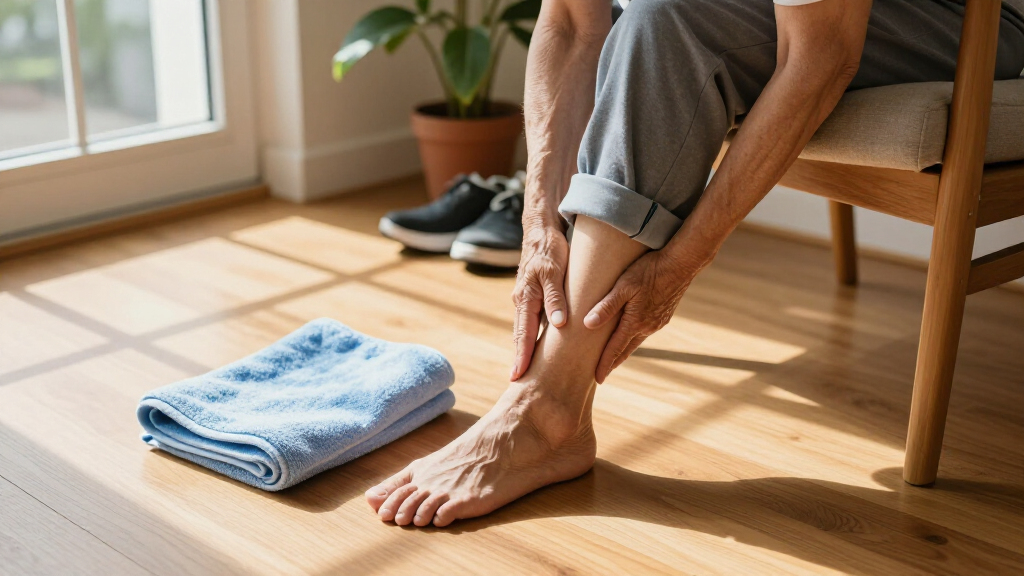

TL;DR

Get health and wellness essentials delivered free with Prime
- Fast, free delivery on millions of items
- Prime Video, Amazon Music and more included
- Member-only deals all year
A randomized trial found that people with mild to moderate arthritis on the inner side of the knee reported less pain after learning a foot angle selected to reduce loading on their affected joint. The 68-person study also reported signs of slower cartilage deterioration, but the findings do not establish that gait retraining restores cartilage or works for everyone.
A 68-person randomized trial found that people with mild to moderate osteoarthritis on the inner side of the knee reported less pain after learning a personalized change in foot angle while walking. The findings, published in The Lancet Rheumatology in August 2025, suggest gait retraining may offer a non-drug option for some patients, but do not show that the approach suits everyone or restores damaged cartilage.
Researchers from the University of Utah, New York University and Stanford University compared individualized walking instructions with a sham intervention. All participants went through a training process, but only one group was instructed to change its foot position; the comparison group was told to keep its natural angle. Each group included 34 participants.
Before training, participants walked on a sensor-equipped treadmill while cameras recorded their movement. They tried turning their toes 5 or 10 degrees inward or outward. Researchers selected the adjustment that reduced loading on each participant’s affected knee. People for whom none of the tested positions reduced loading were not included in the trial.
After one year, the personalized-training group reported significantly less knee pain than the sham group. The report also describes encouraging signs of slower cartilage deterioration. The available source does not provide the exact pain-score difference, the detailed cartilage measurements, or the full results for other outcomes, so the size and clinical importance of those effects cannot be assessed here.
A Walking Strategy Beyond Pain Relief
The approach targets how force moves through the knee, rather than treating symptoms alone. In osteoarthritis affecting the inner knee, repeated loading of that compartment may contribute to worsening damage. A foot-angle adjustment selected for an individual could reduce some of that pressure during ordinary walking.
That makes the reported cartilage findings relevant, because existing care can help manage symptoms but does not reliably restore cartilage lost to osteoarthritis. Still, this trial does not establish that gait retraining prevents disease progression or avoids surgery. The reported pain relief was comparable in magnitude to benefits reported for some commonly used medicines, according to the source report, but the supplied material gives no numerical comparison or head-to-head medication trial.
For readers, the main practical point is that this was a supervised, measured intervention, not evidence that everyone should deliberately alter their stride. The adjustment differed from person to person, and a position that helps one knee may not help another.
knee arthritis gait retraining shoes
As an affiliate, we earn on qualifying purchases.
As an affiliate, we earn on qualifying purchases.
Why Researchers Personalized Foot Angle
The trial focused on osteoarthritis in the medial compartment, the inner section of the knee. The source report says this area commonly carries more load during normal walking. Researchers tested modest changes in toe direction because inward or outward rotation can alter forces acting on the joint.
Earlier gait-retraining studies prescribed the same walking pattern to participants, according to co-lead researcher Scott Uhlrich. The report says some people in those studies did not reduce knee loading, and some may have increased it. This trial instead tested several positions and assigned a change only when measurements showed it reduced loading.
Osteoarthritis gradually damages cartilage, which cushions the ends of bones. It can make walking, climbing stairs and standing from a chair painful. Exercise, physical therapy, weight management and medicines can help manage symptoms; people with advanced disease may eventually undergo joint replacement. The trial’s findings apply specifically to its selected group, not to every type or stage of knee arthritis.
“We’ve known that for people with osteoarthritis, higher loads in their knee accelerate progression, and that changing the foot angle can reduce knee load.”
— Scott Uhlrich, assistant professor of mechanical engineering at the University of Utah and trial co-lead
Limits of the One-Year Trial
The study included 68 participants with mild to moderate arthritis in the inner knee, and people without a tested adjustment that lowered loading were excluded. The results therefore may not apply to people with more advanced disease, arthritis in other parts of the knee, or those whose walking mechanics respond differently.
The source material does not specify the exact pain-score change, the size of the cartilage effect, the adverse effects recorded, or whether the benefits lasted beyond one year. It also does not establish whether this training changes the need for medication or surgery. A reported sign of slower cartilage deterioration is not the same as proof that cartilage was repaired or that progression was stopped.
Because foot-angle changes can alter joint forces in different ways, readers should not assume that copying an inward or outward adjustment from another person is safe or effective for them. The trial tested individualized selection using laboratory measurements, rather than unsupervised changes at home.
Testing Wider Clinical Use
The supplied report does not identify a follow-up trial, a planned publication date, or a timetable for routine clinical use. Researchers and clinicians would need further evidence on larger and more varied groups, the durability of pain relief, cartilage outcomes, and how the approach could be delivered outside a specialized laboratory.
For now, the study adds evidence that personalized gait retraining may help some people with medial knee osteoarthritis. Anyone considering a change to walking mechanics should discuss it with a qualified health professional, who can assess whether the approach is appropriate rather than relying on a generic foot-angle instruction.
Key Questions
What did the trial test?
It tested whether a person-specific change in foot angle could reduce loading on the inner part of the knee and improve outcomes for people with mild to moderate osteoarthritis there.
How many people took part?
The trial randomly assigned 68 participants: 34 received personalized walking instructions and 34 received a sham intervention that asked them to keep their natural foot angle.
Did the study show that walking changes rebuild cartilage?
No. The report describes signs of slower cartilage deterioration, but it does not say that cartilage was restored or that osteoarthritis progression was stopped.
Should everyone with knee arthritis change their foot angle?
No. The intervention was selected through individual measurements, and some prospective participants were excluded because none of the tested adjustments reduced knee loading. The findings do not support copying another person’s walking pattern.
When was the research published?
The trial findings were published in The Lancet Rheumatology in August 2025. ScienceDaily reported on the research in October 2026.
Source: rss
Columbus Day / Indigenous Peoples' Day Picks
long weekend sales
As an affiliate, we earn on qualifying purchases.