
TL;DR

Get health and wellness essentials delivered free with Prime
- Fast, free delivery on millions of items
- Prime Video, Amazon Music and more included
- Member-only deals all year
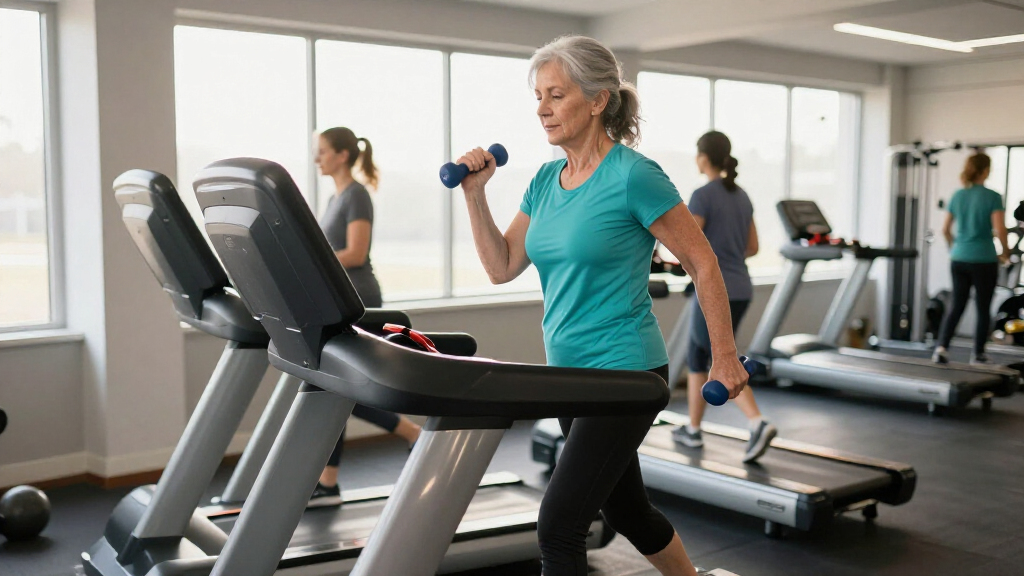
A Sixty and Me article by sports scientist and trainer Patricia Siegel recommends combining endurance and strength training for women over 60, rather than choosing one over the other. It outlines example sessions but is an expert’s proposed framework, not a new clinical guideline; individual safety and the best routine depend on a person’s health and abilities.
A report published by Sixty and Me argues that women over 60 should include both endurance exercise and strength training, rather than treating cardio and weights as competing choices. Author Patricia Siegel, identified by the publication as a sports scientist and personal trainer, sets out a sample weekly routine, but the article does not present it as a formal medical or public-health guideline.
Siegel’s proposed endurance plan has two parts. She describes Zone 2 exercise as a moderate, conversational effort and suggests two sessions a week of about 35 to 45 minutes. Her suggested way to judge the effort is the talk test: a person should be able to speak in sentences but not sing. Walking can serve as an entry point, she writes, with pace or terrain adjusted as fitness develops.
For harder efforts, Siegel recommends interval training, alternating a challenging effort with recovery. Her beginner example is about 30 seconds of hard effort followed by a minute of easier movement, repeated four or five times. She advises limiting intervals to one or two sessions per week. These figures are her recommendations in the article, not a prescription tailored to each reader.
For resistance exercise, Siegel suggests three strength sessions weekly, using either full-body workouts or a split between upper- and lower-body days. She describes progressive overload—gradually changing weight, repetitions, sets or movement tempo—as a way to keep challenging muscles. Her example is three or four sets of 10 to 12 repetitions, ending with roughly two repetitions still possible. She also says impact movements such as hops or heel drops may add a bone-loading stimulus when performed safely.
Why a Combined Routine Matters
The report’s central message is that a routine focused only on walking or only on weights leaves out other forms of exercise. It frames endurance work as supporting cardiovascular fitness and strength work as helping maintain muscle and function, while noting that bone health is another concern. The practical point for readers is the value of planning across exercise types rather than assuming one activity meets every fitness goal.
The article cites U.S. figures to illustrate the health context: it says cardiovascular disease kills more women than all forms of cancer combined, and that about one in two women over 50 will break a bone because of osteoporosis. It also cites 2022 data showing 13.9% of U.S. adults aged 65 and older met both federal aerobic and muscle-strengthening guidelines in their leisure time. These figures are presented in the source article; they do not establish that Siegel’s particular weekly schedule prevents disease or injury.
For older adults, the recommendations also raise practical questions about balance, joint health, prior injuries and access to equipment or instruction. A general framework can help organize activity, but safe participation may require adjustments based on individual circumstances.
Products Worth Considering

BowFlex Results Series SelectTech 552 Adjustable Dumbbell

BowFlex Results Series SelectTech Dumbbells

Hyperice Normatec 3 Leg Compression Boots – Standard Size
As an affiliate, we earn on qualifying purchases.
The Routine Siegel Proposes
Siegel’s sample week distributes sessions across six days: lower-body strength on Monday, Zone 2 exercise on Tuesday, upper-body strength on Wednesday, intervals on Thursday, Zone 2 on Friday and another upper-body strength session on Saturday, with Sunday as a rest day. It is an example rather than a requirement, and the article does not report a study testing that exact schedule.
The report also pushes back on conflicting advice it says women encounter, including claims that walking alone is enough, that strength work should be avoided because of fragile bones, or that a weighted vest is the sole answer for bone health. Siegel’s alternative is a combination of endurance and resistance training, with impact work added where appropriate. She identifies herself as the author of a forthcoming Johns Hopkins book on menopause strength and endurance training, expected in spring 2028, according to the article.
“there is no one or the other, no magic pill and no shortcut”
— Patricia Siegel, as quoted in Sixty and Me
Limits of the Exercise Advice
The supplied material does not identify a publication date, provide links to the underlying research behind each health statistic, or describe a clinical trial of the suggested schedule. It is therefore not possible from the source alone to verify how the article selected or calculated those figures, or whether its weekly plan is suitable for a particular person.
Siegel’s advice about adding hops, jumps or other impact movements does not specify screening criteria or modifications for people with osteoporosis, balance problems, pain or previous fractures. The report says such movements should be done safely but does not explain how to assess that. Readers with health concerns or limitations should seek advice from a qualified health professional before making substantial exercise changes.
How Readers Can Apply the Plan
The article does not announce a research follow-up, new guideline or policy change. Its next step for readers is to use the proposed mix as a planning framework, adapting session type, duration and intensity to their current activity and abilities. The publication invites readers to consider how much exercise they currently fit into a week and what gets in the way.
Any broader guidance would need to come from public-health authorities or clinical sources, and the article’s suggested schedule should not be mistaken for individualized instruction. Siegel’s forthcoming book is listed for spring 2028, but the supplied report provides no further details about its release.
Key Questions
What is the main recommendation in the report?
Patricia Siegel recommends combining endurance exercise and strength training rather than choosing only cardio or only weights. The report also suggests impact work for bone loading when it can be done safely.
How much Zone 2 exercise does Siegel suggest?
She proposes two sessions a week of about 35 to 45 minutes, at a pace where speaking in sentences is possible but singing is not. This is her framework, not individualized medical advice.
How often does the article recommend strength training?
Siegel suggests three strength sessions per week, either as full-body sessions or a split routine. She describes gradually increasing the challenge over time.
Does the report say walking is enough?
No. It presents walking as an accessible starting point for endurance exercise, while arguing that people may need to adjust pace, terrain or activity as they adapt. It also recommends strength work as part of the overall routine.
Is the sample plan safe for everyone over 60?
The report does not establish that the schedule or impact exercises are suitable for everyone. People with health conditions, balance concerns, pain or a history of fractures should consult a qualified health professional about appropriate exercise options.
Source: rss