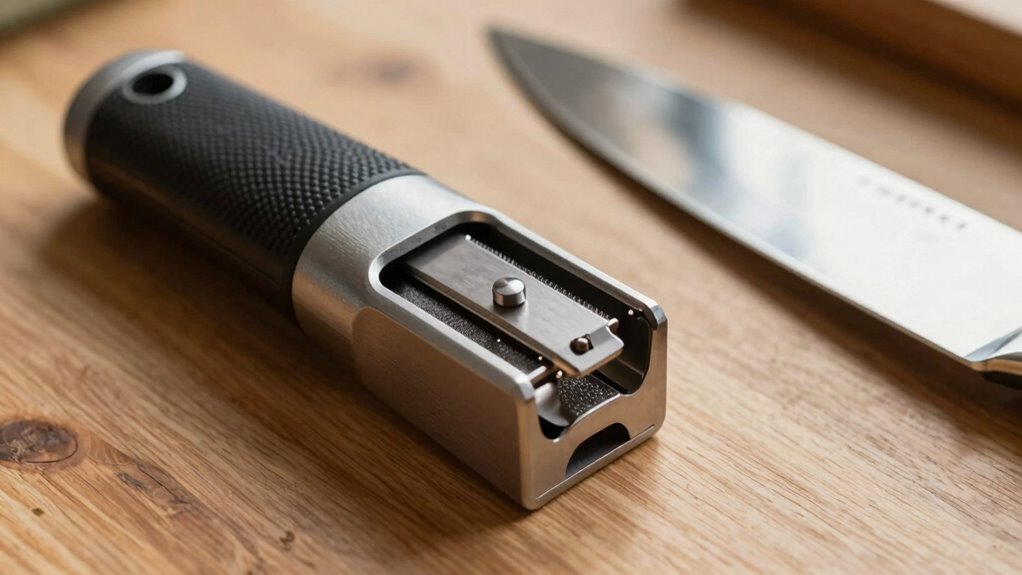
Manual knife sharpeners promise something electric sharpeners can’t: cheap, quiet, portable edge restoration that anyone can use at the kitchen counter. The tradeoffs you face in this category are consistent across the board — pull-through convenience versus edge quality, fixed angles versus adjustability, and low prices versus abrasive longevity. Chef’sChoice ProntoPro #4643 earns my top spot because its diamond abrasives and dual 15°/20° geometry deliver a noticeably sharper, longer-lasting edge than anything else in this lineup. Chef’sChoice Pronto Hone follows closely for 15-degree knife owners who want similar precision at a simpler spec, while Sharp Pebble 5 Precision Adjust stands out as the only genuinely angle-adjustable option for sharpening enthusiasts. If you just want functional knives for under twenty dollars, the AccuSharp and KitchenIQ Edge Grip cover the basics. Keep reading for the full breakdown, including which budget models eat too much steel and which ones actually hold up.

Get health and wellness essentials delivered free with Prime
- Fast, free delivery on millions of items
- Prime Video, Amazon Music and more included
- Member-only deals all year
Key Takeaways
- Diamond abrasives were the clearest performance divider: the amazon.com/dp/B002JIMVS0?tag=rachaelsrawfood-20&ascsubtag=dc-635960″ target=”_blank” rel=”nofollow sponsored noopener”>Chef’sChoice ProntoPro and Pronto Hone both produced cleaner, more durable edges than the carbide-heavy budget models, which remove steel aggressively and rough up the edge.
- Every sub-$20 option in this roundup carries the same hidden cost — faster blade wear — making the Chef’sChoice models cheaper to own over years despite higher upfront prices.
- Serrated knife support is rarer and weaker than marketing suggests: only Chef’sChoice, Orange Ninja, and Longzon genuinely handle serrations, and several three-stage claims only strop the flat side of the blade.
- Angle adjustability barely exists in this category — Sharp Pebble 5 Precision Adjust and RazorSharp are the only real options, making them the default picks for anyone maintaining Japanese knives at non-standard angles.
- Included accessories like cut-resistant gloves (Amazon Basics, 3-Stage, Longzon) and suction bases (Sharpal 191N) did not correlate with sharpening performance and shouldn’t drive a purchase decision on their own.
| Chef’sChoice Pronto Hone Professional Manual Knife Sharpener |  | Best Overall | Brand: Chef’sChoice | Model: Pronto Hone | Sharpening Stages: 2 | VIEW ON AMAZON | See Our Full Breakdown |
| Amazon Basics 4-in-1 Kitchen Knife Sharpener with Nonslip Base and Safety Glove |  | Best Value Pick | Sharpening System: 4-in-1 | Knife Stages: Coarse, medium, fine | Scissor Sharpening: Dedicated slot | VIEW ON AMAZON | See Our Full Breakdown |
| 3-Stage Kitchen Knife Sharpener with Cut-Resistant Glove |  | Best for Beginners | Brand: Kitchellence | Model: KS37 P | Sharpening Stages: 3 | VIEW ON AMAZON | See Our Full Breakdown |
| AccuSharp Gourmet 15-Degree Knife Sharpener |  | Best Compact Pick | Brand: AccuSharp | Model: AS129C | Knife Angle: 15 degrees | VIEW ON AMAZON | See Our Full Breakdown |
| SHARPAL 191N 3-Stage Knife & Scissors Sharpener with Suction Base |  | Best Hands-Free Design | Brand: SHARPAL | Model Number: 191H | Stages: 3 — tungsten carbide edge setting, ceramic honing, scissors sharpening | VIEW ON AMAZON | See Our Full Breakdown |
| KitchenIQ Edge Grip 2-Stage Knife Sharpener |  | Best Budget Pick | Stages: 2 | Coarse sharpener: Carbide blade | Fine sharpener: Ceramic rod | VIEW ON AMAZON | See Our Full Breakdown |
| Grihot VN3 Professional 3-Action Knife Sharpener with Tungsten Carbide |  | Best Premium Build | Dimensions: 4.5″ L x 3.5″ W x 6.5″ H | Weight: 1.93 lbs | Material: 304 stainless steel, tungsten carbide | VIEW ON AMAZON | See Our Full Breakdown |
| Orange Ninja 4-Stage Serrated & Kitchen Knife Sharpener |  | Best for Serrated Knives | Stages: 4 (coarse, medium, fine, serrated) | Coarse slot material: Carbide blades | Medium slot material: Diamond sharpening rods | VIEW ON AMAZON | See Our Full Breakdown |
| Kitchen Knife Sharpener with Diamond Abrasive Wheels |  | Best for Scissors | Abrasive material: Diamond grinding wheels | Base: Non-slip | Debris collection: Removable compartment | VIEW ON AMAZON | See Our Full Breakdown |
| Chef’sChoice ProntoPro Manual Knife Sharpener #4643 |  | Best Overall | Model: ProntoPro #4643 | Stages: 2-stage sharpening with separate honing/polishing stage | Abrasive: 100% diamond abrasives | VIEW ON AMAZON | See Our Full Breakdown |
| Henckels Handheld Knife Sharpener | 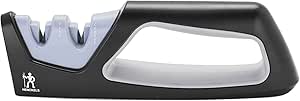 | Best Trusted-Brand Pick | Brand: HENCKELS | Model Number: 11299-401 | Sharpening Stages: 2-stage coarse and fine ceramic grits | VIEW ON AMAZON | See Our Full Breakdown |
| Sharp Pebble 5 Precision Adjust 3-Stage Manual Kitchen Knife Sharpener |  | Best for Angle Control | Brand: Sharp Pebble | Model Number: 4KS | Stages: 3 | VIEW ON AMAZON | See Our Full Breakdown |
| Longzon 5-in-1 Manual Knife Sharpener with Cut-Resistant Glove |  | Best Accessorized Value | Sharpening Stages: 4 | Compatible Blades: Kitchen knives, stainless steel knives, scissors, and pocket knives | Material: ABS and abrasive components | VIEW ON AMAZON | See Our Full Breakdown |
| RazorSharp Knife and Scissor Sharpener with Adjustable Angle Guide |  | Best Abrasive Quality | Adjustable Sharpening Angle: 14–24 degrees | Sharpening Stones: Diamond-coated ceramic | Frame Material: ABS plastic | VIEW ON AMAZON | See Our Full Breakdown |
| AccuSharp Knife Sharpener with Ergonomic Handle, White |  | Best for Serrated Knives | Brand: AccuSharp | Color: White | Sharpener Material: Diamond-honed tungsten carbide | VIEW ON AMAZON | See Our Full Breakdown |
More Details on Our Top Picks
Chef’sChoice Pronto Hone Professional Manual Knife Sharpener
The Pronto Hone earns the top spot because it solves the biggest weakness of manual sharpeners: consistency. Most budget models, like the Kitchellence 3-Stage or the Amazon Basics 4-in-1, leave you guessing at angle control, but the fixed 15-degree diamond abrasive slots do that work for you — you just pull the blade through. The two-stage build shapes and then hones, producing an arch-shaped edge that holds up longer than the flat V-edges cheaper pull-throughs create. It also handles serrated knives, which the Amazon Basics model flatly can’t. The tradeoff is specificity: this is built for 15-degree Asian-style edges, so it isn’t the right tool if your drawer is full of 20-degree European blades. It’s also less convenient than an electric sharpener if you sharpen daily.
Pros:- Diamond abrasives sharpen and hone for a durable arch-shaped edge
- CrissCross technology creates sharp edges with real cutting bite
- Handles both straight-edge and serrated knives
- Precise angle control removes the guesswork from manual sharpening
Cons:- Only suited to 15-degree edges, not the whole knife drawer
- Requires a few practice passes before results become consistent
- Slower than electric sharpeners for frequent, high-volume use
Best for: Cooks with Asian-style 15-degree knives (Santoku, Japanese gyuto) who want professional-quality edges without freehand skill
Not ideal for: Households with mixed 20-degree European knives or heavy daily sharpening loads — the fixed angle and manual operation become limiting
- Brand:Chef’sChoice
- Model:Pronto Hone
- Sharpening Stages:2
- Edge Angle:15 degrees
- Abrasive Material:100% diamond
- Compatible Knives:Straight-edge and serrated
- Technology:CrissCross
- Material:Stainless steel
Our verdict“If your knives are 15-degree blades and you want one sharpener that delivers repeatable, near-professional edges, this is the one to buy.”
Amazon Basics 4-in-1 Kitchen Knife Sharpener with Nonslip Base and Safety Glove
For shoppers who want the most functionality per dollar, this 4-in-1 design covers ground that pricier single-purpose tools don’t. Three knife stages (coarse, medium, fine) let you repair a chipped blade or just touch one up, and the dedicated scissor slot is something the Chef’sChoice Pronto Hone doesn’t offer at all. The included cut-resistant glove and silicone nonslip base are thoughtful touches for nervous beginners — the Kitchellence 3-Stage includes a glove too, but lacks the scissor function. The real limitation is blade coverage: unlike the Pronto Hone or the AccuSharp Gourmet, it cannot handle serrated knives, so bread knives and serrated parers stay dull. Build quality is serviceable rather than refined, and the abrasives will wear faster than diamond ones under heavy use.
Pros:- Coarse, medium, and fine stages handle both repairs and touch-ups
- Dedicated scissor slot adds versatility most knife-only sharpeners lack
- Works on kitchen, pocket, and hunting knives
- Nonslip base and included safety glove make it beginner-friendly
Cons:- Not compatible with serrated knives
- Standard abrasives wear faster than diamond systems under frequent use
Best for: Budget-conscious home cooks who want one inexpensive tool for straight-edge kitchen, pocket, and hunting knives plus scissors
Not ideal for: Anyone with serrated knives to maintain, or buyers who expect diamond-grade abrasive durability over years of use
- Sharpening System:4-in-1
- Knife Stages:Coarse, medium, fine
- Scissor Sharpening:Dedicated slot
- Compatible Blades:Kitchen, pocket, and hunting knives (straight edge only)
- Not Compatible With:Serrated knives
- Base:Non-slip silicone
- Included Accessories:Cut-resistant safety glove
- Cleaning:Rinse or wash with soapy water
Our verdict“A sensible low-cost choice for straight-edge blades and scissors, as long as serrated knives aren’t part of the picture.”
3-Stage Kitchen Knife Sharpener with Cut-Resistant Glove
This Kitchellence model is the easiest entry point into knife sharpening in this lineup. The repair-sharpen-polish progression walks new users through the process in a logical order, and the ergonomic handle plus nonslip base mean you’re not fighting the tool while learning the motion. Ambidextrous design matters here too — most competitors, including the AccuSharp Gourmet, are fine for lefties but don’t advertise it. Compared with the Amazon Basics 4-in-1, you give up the scissor slot, and unlike the Chef’sChoice Pronto Hone there’s no diamond abrasive or specified edge geometry, so edge quality lands a notch below the premium picks. The bigger frustration for a careful buyer is that blade compatibility isn’t clearly documented, so serrated-knife owners are taking a gamble. For a first sharpener that won’t intimidate, though, it nails the basics.
Pros:- Three-stage system logically moves from repair to polish
- Designed for both left- and right-handed users
- Ergonomic handle and non-slip base keep operation steady
- Cut-resistant glove included for beginner confidence
Cons:- Blade compatibility isn’t specified, creating uncertainty for serrated owners
- No premium abrasives or angle control compared with diamond-based models
Best for: First-time knife sharpeners and casual home cooks who want a simple, guided three-step process with safety features included
Not ideal for: Enthusiasts who care about specific edge angles, or owners of serrated knives — compatibility isn’t documented
- Brand:Kitchellence
- Model:KS37 P
- Sharpening Stages:3
- Material:ABS plastic
- Included Components:Cut-resistant glove
- Handedness:Left and right handed
- Color:Black
Our verdict“A forgiving starter sharpener that teaches the fundamentals, bested only by pricier tools once you develop standards for edge quality.”
AccuSharp Gourmet 15-Degree Knife Sharpener
Where the other sharpeners here are countertop tools, the AccuSharp Gourmet is a pocket-friendly handheld you can toss in a drawer, camping kit, or tackle box. Its diamond-honed tungsten carbide blades cut aggressively and — a genuinely smart design choice — are reversible, doubling effective blade life compared with one-sided models like the SHARPAL 191N. The full-length finger guard is more protective than the basic bases on the Kitchellence or Amazon Basics units, which matters when you’re sharpening outdoors without a stable counter. Like the Chef’sChoice Pronto Hone, it handles both straight-edge and serrated blades, but it’s a single-stage hone-and-refine tool rather than a multi-stage system, so it refreshes edges rather than rebuilding badly damaged ones. And it shares the Pronto Hone’s 15-degree specialization, so thicker European edges aren’t its job.
Pros:- Compact handheld format travels easily
- Reversible tungsten carbide blades double usable life
- Full-length finger guard adds real hand protection
- Sharpens both straight-edge and serrated knives
Cons:- Single-stage design refreshes edges but can’t reprofile damaged blades
- Limited to 15-degree edge geometry
Best for: Campers, anglers, and minimalists who need a durable sharpener that travels and refreshes edges on the go
Not ideal for: Cooks with dull or damaged blades needing full reprofiling, or anyone with 20-degree European knives
- Brand:AccuSharp
- Model:AS129C
- Knife Angle:15 degrees
- Blade Material:Diamond-honed tungsten carbide
- Blade Design:Reversible
- Compatible Knives:Straight-edge and serrated
- Safety Feature:Full-length finger guard
- Handle:Ergonomic
Our verdict“The right pick if portability and blade longevity matter more than multi-stage refinement.”
SHARPAL 191N 3-Stage Knife & Scissors Sharpener with Suction Base
The SHARPAL 191N takes a different approach to safety than everything else here: instead of a glove or a nonslip pad like the Amazon Basics model, its suction base bolts the sharpener to any smooth counter, freeing both hands to guide the blade. That makes it the safest option in the lineup for anyone uneasy about sharpening — and it works equally well for left- and right-handed users, matching the Kitchellence’s ambidextrous design. The tungsten carbide and ceramic stage pairing covers both fast edge setting and finer honing, plus a dedicated scissor slot the Chef’sChoice Pronto Hone lacks. The catch is the mounting requirement: on textured tile, wooden, or uneven surfaces, the suction fails and the hands-free advantage disappears entirely. The 3-year warranty is a confidence booster for a tool in this price class, though it excludes commercial use.
Pros:- Suction base enables genuinely hands-free, stable sharpening
- Tungsten carbide and ceramic stages cover both edge setting and honing
- Dedicated scissor slot adds versatility
- 3-year warranty and ambidextrous operation
Cons:- Requires a smooth, flat surface for the suction base to function
- Warranty excludes commercial use
Best for: Safety-focused home cooks and anyone with limited hand dexterity who benefits from a mounted, two-handed sharpening setup
Not ideal for: Kitchens with textured or uneven countertops — the suction mount won’t hold, defeating the design
- Brand:SHARPAL
- Model Number:191H
- Stages:3 — tungsten carbide edge setting, ceramic honing, scissors sharpening
- Base:Suction cup with high suction force
- Handedness:Left and right handed
- Warranty:3 years (non-commercial use)
- Design:Compact, space-saving
Our verdict“The most stable and safest manual sharpening experience available here, provided your countertop cooperates.”
KitchenIQ Edge Grip 2-Stage Knife Sharpener
When a sharpener costs about as much as a coffee, expectations should be calibrated — but the Edge Grip still manages to cover the fundamentals better than pricier rivals. Its carbide stage bites into genuinely dull blades, while the ceramic rod handles touch-ups, and the edge-grip design hooks onto your countertop so you can pull a blade through with confidence instead of chasing a sliding block around the counter.
Compared with the Orange Ninja 4-Stage, you give up the dedicated serrated and medium slots, and unlike the SHARPAL 191N, there’s no scissors option. But for a two-stage workflow that fits in a drawer and costs pocket change, this option stands out as the low-risk entry point. Just know that heavily chipped knives will overwhelm the carbide stage, and every pass takes manual effort.
Pros:- Two-stage system handles both dull blades and fine touch-ups
- Edge-grip design anchors to countertop edges for stable sharpening
- Genuinely compact — disappears into any drawer
- Preset angles remove guesswork for beginners
Cons:- Fully manual operation demands physical effort and repeated pulls
- No dedicated slot for heavily damaged or chipped edges
Best for: Budget-conscious home cooks who want a reliable backup sharpener that stores in a drawer
Not ideal for: Anyone with damaged or chipped blades or a large knife collection needing versatile slot options
- Stages:2
- Coarse sharpener:Carbide blade
- Fine sharpener:Ceramic rod
- Knife compatibility:Straight and serrated knives
- Base:Non-slip
- Color:Black
Our verdict“A no-frills two-stage sharpener that makes the most sense for casual cooks who want sharp knives without spending real money.”
Grihot VN3 Professional 3-Action Knife Sharpener with Tungsten Carbide
Most pull-through sharpeners in this roundup live in plastic housings; the Grihot VN3 goes the other direction with solid 304 stainless steel construction that feels like shop equipment rather than a kitchen gadget. Its defining feature is the pair of spring-loaded tungsten carbide arms that self-adjust to each blade’s angle, which sidesteps the biggest weakness of fixed-slot models like the KitchenIQ Edge Grip, where mismatched geometry can shave away more steel than needed.
The three-action base lets you move between repair, restoration, and sharpening — a step up from simple two-stage sharpeners. The tradeoff is weight and bulk: at nearly two pounds it’s a countertop resident, not a drawer sharpener, and ceramic blade owners are out of luck. For buyers who sharpen often and want hardware that outlasts the knives, the long warranty reinforces the premium positioning.
Pros:- Self-adjusting carbide arms fit a wide range of edge angles without guesswork
- 304 stainless steel and tungsten carbide build built for years of heavy use
- Handles kitchen, serrated, and pocket knives across three distinct actions
- Backed by an unusually long 60-month warranty
Cons:- Nearly 2 pounds and over 6 inches tall — takes up counter space
- Not compatible with ceramic blades
Best for: Serious cooks and professionals who sharpen frequently and want tank-like durability with adaptive angle control
Not ideal for: Ceramic knife owners and anyone wanting a compact tool that tucks into a drawer
- Dimensions:4.5″ L x 3.5″ W x 6.5″ H
- Weight:1.93 lbs
- Material:304 stainless steel, tungsten carbide
- Actions:3 (repair, restoration, sharpening)
- Warranty:60 months
Our verdict“This pick makes the most sense for frequent sharpeners who prioritize build quality and adaptive angles over portability.”
Orange Ninja 4-Stage Serrated & Kitchen Knife Sharpener
Few budget sharpeners give serrated blades their own dedicated slot, and that’s where the Orange Ninja earns its place. With coarse carbide, diamond medium, fine polishing, and a serrated slot all in one unit, it covers more blade types than the KitchenIQ Edge Grip while remaining just as approachable. The ambidextrous ergonomic handle is a thoughtful touch that most competitors — including the Amazon Basics 4-in-1 — don’t prioritize, making it a rare fit for left-handed cooks.
The multi-stage progression lets you match aggression to condition: a few pulls through fine for maintenance, carbide for genuinely tired edges. Technique matters here more than with spring-loaded models like the Grihot VN3 — a sloppy back-and-forth sawing motion can round an edge rather than refine it, and badly chipped blades exceed what the carbide slot can repair. Sharpen with consistent one-direction pulls and it rewards you with a very sharp edge quickly.
Pros:- Four dedicated stages including a true serrated slot
- Ambidextrous ergonomic handle suits right- and left-handed users
- Handles chef, paring, pocket, and hunting knives
- Durable ABS body stands up to regular kitchen use
Cons:- Improper back-and-forth technique can damage blade edges
- Limited effectiveness on severely damaged blades
Best for: Households mixing straight and serrated knives, and left-handed users underserved by most sharpeners
Not ideal for: Owners of severely chipped blades or those unwilling to maintain proper pull technique
- Stages:4 (coarse, medium, fine, serrated)
- Coarse slot material:Carbide blades
- Medium slot material:Diamond sharpening rods
- Handle:Ergonomic, ambidextrous
- Body material:ABS plastic
- Type:Manual pull-through sharpener
Our verdict“If your knife block includes bread knives and steak knives alongside chef’s knives, this is the budget-friendly tool that covers them all.”
Kitchen Knife Sharpener with Diamond Abrasive Wheels
Scissors compatibility is the quiet differentiator here. Where the Chef’sChoice ProntoPro explicitly excludes scissors, this sharpener’s diamond grinding wheels handle both kitchen knives and shears, which explains its inclusion over otherwise similar pull-through models. Diamond abrasive also cuts faster than the ceramic rods found in the KitchenIQ Edge Grip, so dull blades come back to working order in fewer passes — a real benefit if your elbows dislike repetitive sharpening.
The removable debris compartment is a detail competitors ignore, containing steel filings instead of scattering them across the counter. Two tuning knobs let you adjust wheel positioning, though this introduces a small learning curve: blades must stay perpendicular to the wheels or they spin idle without cutting. It’s a modest learning curve, but one the simpler fixed-slot sharpeners in this roundup avoid entirely.
Pros:- Diamond grinding wheels restore dull blades faster than ceramic alternatives
- Sharpens both kitchen knives and scissors
- Removable debris compartment keeps counters clean
- Non-slip base and compact drawer-friendly footprint
Cons:- Blades must be held perpendicular or the wheels spin without sharpening
- Adjustment knobs add setup complexity compared with fixed-slot sharpeners
Best for: Households that want one tool to maintain both kitchen knives and scissors with fast diamond abrasion
Not ideal for: Buyers wanting zero adjustment or technique — the perpendicular requirement and tuning knobs add a learning curve
- Abrasive material:Diamond grinding wheels
- Base:Non-slip
- Debris collection:Removable compartment
- Adjustment:Two tuning knobs
- Type:Manual pull-through sharpener
- Compatible with:Kitchen knives, chef knives, scissors
Our verdict“This model is better suited to multitasking households that value speed and scissors support over plug-and-play simplicity.”
Chef’sChoice ProntoPro Manual Knife Sharpener #4643
The ProntoPro #4643 tops this roundup because it solves the problem most manual sharpeners ignore: edge angle. By offering dedicated geometry for both 15° Asian-style and 20° European/American knives, it sharpens a Santoku correctly instead of forcing it through a one-size-fits-all slot — something the KitchenIQ Edge Grip and Orange Ninja simply can’t do. Its CrissCross diamond technology creates an arch-shaped, burr-free edge that holds up noticeably longer than the single-bevel results from basic carbide slots.
Compared with the Grihot VN3, you lose the spring-loaded auto-angle adjustment but gain precision-engineered fixed guides that many sharpeners struggle to match, plus US assembly and a polished honing stage. The limitations are real but narrow: it won’t touch scissors, and chipped blades need professional regrinding first. For anyone maintaining a quality mixed-angled knife collection, this is the standard the rest of the lineup is measured against.
Pros:- Dedicated 15° and 20° angle guides match both Asian and Western knives
- 100% diamond abrasives produce sharp, burr-free, long-lasting edges
- Separate honing/polishing stage refines rather than just sharpens
- Handles straight, serrated, Santoku, sports, and pocket knives
Cons:- Requires more manual effort than electric alternatives
- Not suitable for scissors or very damaged/chipped blades
Best for: Enthusiasts with mixed Asian and European knife collections who want precise, durable edges
Not ideal for: Scissor sharpeners and owners of heavily chipped blades requiring regrinding
- Model:ProntoPro #4643
- Stages:2-stage sharpening with separate honing/polishing stage
- Abrasive:100% diamond abrasives
- Edge angles:15° and 20°
- Knife types:Straight edge, serrated, Santoku, sports and pocket knives
- Technology:CrissCross sharpening
- Handle:Soft Touch comfortable grip
- Origin:Engineered and assembled in USA
- Color:Gray
Our verdict“For buyers who care about edge geometry and edge retention across a serious knife collection, this is the manual sharpener to beat.”
Henckels Handheld Knife Sharpener
This Henckels model stands out for pairing two ceramic stages with genuinely thoughtful ergonomics — the contoured handle, finger-protection grip, and rubberized base make it one of the safest handheld designs in this lineup. Ceramic grits are gentler on blades than the tungsten carbide used by the AccuSharp, removing less metal per pass, which matters if you own decent kitchen knives you want to keep for years. Compared with the KitchenIQ Edge Grip, this option gives you better hand protection and ambidextrous use, though it shares the same core limitation of any pull-through design: very dull knives need many repeated passes before they come back to form. It also can’t match the angle control of the Sharp Pebble 5 Precision Adjust, so precision-minded sharpeners will outgrow it.
Pros:- Two ceramic stages are gentler on blade steel than carbide alternatives
- Ergonomic handle with finger-protection grip keeps hands safe
- Rubberized non-slip base adds stability during sharpening
- Works equally well for left- and right-handed users
Cons:- Repeated passes needed to revive genuinely dull knives
- Less stable than bench-mounted or suction-based systems like the SHARPAL 191N
- No angle adjustability for matching different edge geometries
Best for: Home cooks who want a gentle, safe ceramic sharpener from an established knife brand for routine edge maintenance
Not ideal for: Owners of very dull or damaged blades — the mild ceramic abrasives make restoration slow and repetitive
- Brand:HENCKELS
- Model Number:11299-401
- Sharpening Stages:2-stage coarse and fine ceramic grits
- Handle Type:Ergonomic contoured non-slip handle
- Hand Orientation:Left and right handed
- Safety Features:Finger-protection grip and rubberized non-slip base
- Included Components:Handheld knife sharpener
Our verdict“A sensible, blade-friendly choice for maintaining good knives rather than rescuing ruined ones.”
Sharp Pebble 5 Precision Adjust 3-Stage Manual Kitchen Knife Sharpener
Most pull-through sharpeners lock you into one factory angle — this one doesn’t. With five selectable angles from 12° to 24°, the Sharp Pebble 5 lets you match the edge geometry of everything from a thin Japanese-style chef’s knife to a sturdy hunting blade, which no other handheld in this roundup can claim. The three-stage repair-restore-polish sequence gives it more capability than the Henckels’ two ceramic stages when a blade needs real work. The tradeoff is ABS plastic construction rather than premium materials, and like the RazorSharp, it’s strictly for straight-edge blades — if you own serrated bread knives, the AccuSharp handles those and this doesn’t. Buyers used to single-angle sharpeners should also expect a short learning curve picking the right setting.
Pros:- Five adjustable angles (12°–24°) for precise edge matching
- Three-stage system covers repair, restoration, and polishing
- Versatile across kitchen, pocket, and hunting knives
- Durable ABS construction holds up to regular use
Cons:- Not compatible with serrated knives or scissors
- Multiple passes still needed for full sharpening
- Plastic build feels less premium than brand-name alternatives
Best for: Enthusiasts who want to match sharpening angles across kitchen, pocket, and hunting knives without buying a whetstone setup
Not ideal for: Households with serrated knives or scissors in the mix — this sharpener explicitly excludes both
- Brand:Sharp Pebble
- Model Number:4KS
- Stages:3
- Adjustable Angles:12°, 15°, 18°, 21°, 24°
- Compatible Blades:Straight-edge kitchen, pocket, and hunting knives
- Not Compatible With:Serrated knives, scissors
- Material:ABS plastic
Our verdict“The pick for buyers who care about matching angles to their blades rather than just dragging steel through a slot.”
Longzon 5-in-1 Manual Knife Sharpener with Cut-Resistant Glove
The Longzon’s pitch is completeness: four stages covering everything from scissors to polishing, plus a bundled cut-resistant glove that most rivals leave out. That glove is a genuinely useful addition for nervous beginners — the Amazon Basics 4-in-1 includes one too, but the Longzon adds a fourth sharpening stage on top. Its non-slip base and compact footprint make it a sensible kitchen-drawer sharpener for households that sharpen occasionally rather than obsessively. Compared with the Orange Ninja 4-stage, the two are close in capability, so the deciding factor becomes the accessory bundle and stage versatility. The honest limitation: there’s no angle adjustability like the Sharp Pebble 5 offers, and the abrasive quality is adequate rather than exceptional, so serious knife hobbyists will find its edges serviceable but not razor-refined.
Pros:- Four stages handle restoring, refining, and polishing plus scissors
- Cut-resistant glove included for safer handling
- Non-slip base keeps the unit planted during use
- Compact design stores easily in a drawer
Cons:- Manual sharpening demands real user effort and patience
- No angle adjustment to match different blade geometries
- Abrasive longevity details are unclear compared with established brands
Best for: Budget-conscious households that want one tool for knives and scissors, plus safety accessories included
Not ideal for: Precision sharpeners who want selectable angles or finer abrasive control over their final edge
- Sharpening Stages:4
- Compatible Blades:Kitchen knives, stainless steel knives, scissors, and pocket knives
- Material:ABS and abrasive components
- Base:Non-slip
- Included Accessory:Cut-resistant glove
- Color:Black and silver
Our verdict“A well-rounded, accessory-loaded option for casual home use where versatility matters more than refinement.”
RazorSharp Knife and Scissor Sharpener with Adjustable Angle Guide
Where most budget sharpeners use plain carbide or ceramic rods, the RazorSharp uses diamond-coated ceramic stones, which cut faster and hold their abrasive surface longer — a real edge in durability over the plastic-bodied Longzon. Its 14–24° adjustable angle guide puts it in rare company alongside the Sharp Pebble 5, letting you tune the edge to the knife rather than forcing one geometry on everything. The non-slip rubber grips and sturdy ABS frame make it stable enough for countertop use without clamping. The main uncertainty is compatibility documentation: it’s marketed for knives and scissors, but no specifics on scissor angles or serrated blades are provided, so buyers with those needs are gambling a bit where the Longzon is explicit.
Pros:- Diamond-coated ceramic stones cut faster and last longer than plain rods
- Adjustable 14–24° angle guide for edge customization
- Non-slip rubber grips and sturdy frame keep it stable in use
- Solid ABS construction suited to regular home sharpening
Cons:- No clear compatibility details for scissors or serrated blades
- Smaller brand with less established track record than Henckels or Chef’sChoice
- Angle range is narrower than the Sharp Pebble’s five preset options
Best for: Buyers who want faster-cutting diamond abrasives and angle flexibility without a full guided-rod system
Not ideal for: Owners of serrated knives or specialty scissors, since compatibility details are vague on both
- Adjustable Sharpening Angle:14–24 degrees
- Sharpening Stones:Diamond-coated ceramic
- Frame Material:ABS plastic
- Grip:Non-slip rubber
- Operation:Manual
- Use Case:Home knife and scissor sharpening
Our verdict“A strong pick if abrasive quality and angle control top your list and you mostly sharpen plain-edge knives.”
AccuSharp Knife Sharpener with Ergonomic Handle, White
The AccuSharp earns its slot by doing something nearly every other manual sharpener here refuses to: it handles serrated blades alongside straight ones, covering bread knives, filet knives, and even cleavers. Its diamond-honed tungsten carbide blades are reversible, effectively doubling service life — expect five to ten years before replacement — and it restores most edges in about ten seconds, making it faster than the ceramic-stage Henckels for dull blades. The full-length finger guard and ambidextrous grip are more protective than most, and dishwasher-safe cleaning is a convenience nobody else in this lineup offers. The tradeoffs are real, though: aggressive carbide removes more steel than ceramic, there’s no angle guide like the RazorSharp provides, and it won’t sharpen scissors the way the Longzon does.
Pros:- Sharpens both straight and serrated knives, including cleavers and filet knives
- Restores most blades in roughly 10 seconds
- Reversible carbide blades last an estimated 5–10 years
- Dishwasher-safe with full-length guard for ambidextrous, safe use
Cons:- Aggressive carbide removes more blade steel than ceramic alternatives
- No angle guide for matching edge geometry
- Manual operation won’t suit fans of electric or fully guided systems
Best for: Households with mixed straight and serrated knives who want fast results and minimal maintenance
Not ideal for: Owners of premium knives who want precise angle control or minimal steel removal — carbide is aggressive
- Brand:AccuSharp
- Color:White
- Sharpener Material:Diamond-honed tungsten carbide
- Compatible Knife Types:Straight and serrated knives, including chef, paring, filet, and cleaver
- Handle Design:Ergonomic, ambidextrous, full-length guard
- Cleaning:Soap and water or dishwasher safe
- Blade Life:Average 5 to 10 years between replacements
Our verdict“The go-to choice when speed and serrated-blade coverage matter more than precision edge work.”
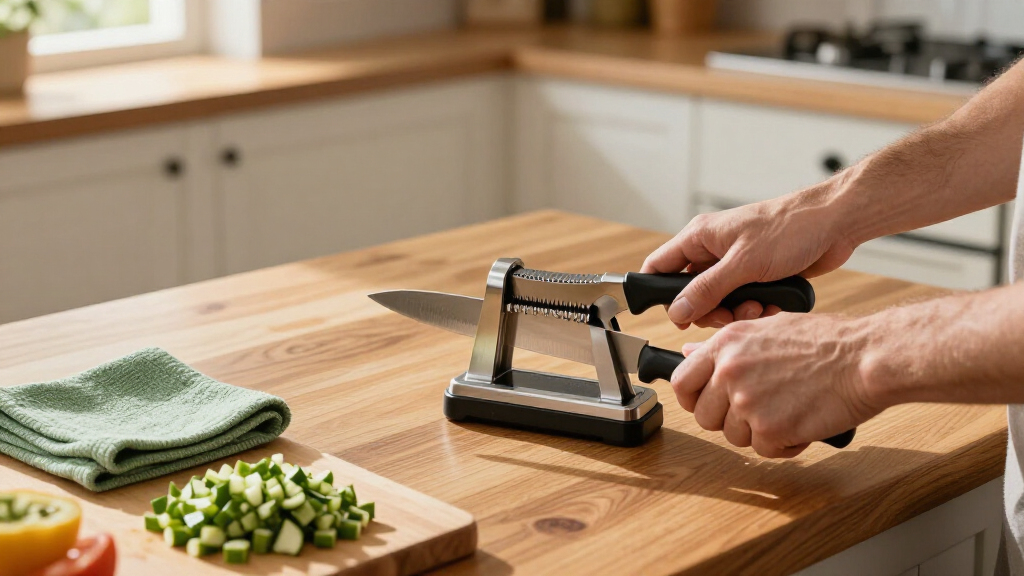
How We Picked
Because manual sharpeners live or die by the edge they produce, I weighted abrasive quality and edge finish above everything else — diamond-coated and ceramic stages consistently outperform bare tungsten carbide, which tears steel away quickly and leaves a rougher, faster-dulling edge. The second criterion was angle handling: whether a sharpener supports 15°, 20°, or adjustable geometry determines which knives it can actually serve without degrading them, which is why the adjustable Sharp Pebble and dual-angle Chef’sChoice models rank above fixed-angle competitors. Third, I judged usability and safety — grip stability, pull-through resistance, hand protection, and whether a beginner could get a decent result without practice.
From there, I factored build durability (how long the abrasive stages last before glazing or wearing out), versatility (serrated blade support, scissors, kitchen shears), and long-term value — a cheap carbide pull-through that eats a blade’s lifespan costs more than its price suggests. Products that ranked lower aren’t bad; they simply serve narrower situations, trade edge quality for price, or duplicate what a higher-ranked model does better.
Factors to Consider When Choosing Manual Knife Sharpeners
Before picking a specific model, it helps to understand what actually separates a good manual sharpener from a blade-damaging one. These are the factors that shaped my rankings — and the mistakes I’d avoid when shopping.Abrasive Type Matters More Than Stage Count
The single biggest quality factor in a manual sharpener is what the sharpening slots are made of. Tungsten carbide removes metal fast, which sounds good until you realize it takes off far more steel than needed and leaves a slightly rough edge that dulls within weeks. Diamond abrasives cut more cleanly and conservatively, and ceramic finishing stages polish the edge into something that lasts months. Marketing that leads with “3-stage” or “4-stage” design often just means extra carbide slots, not better results — a two-stage diamond sharpener will outperform a four-stage carbide one every time. If your knives were expensive, this is the factor worth paying up for.
Match the Angle to Your Knives
Most budget sharpeners force a single fixed angle, usually around 20 degrees, which is fine for Western kitchen knives but wrong for thinner Japanese blades typically ground at 15 degrees. Sharpening a 15° knife at 20° regrinds the edge geometry over time, effectively thickening the blade and dulling its cutting character permanently. Dual-angle models like the Chef’sChoice units let you pick the right setting, while adjustable systems like the Sharp Pebble 5 allow finer control for enthusiasts. The common mistake here is treating sharpeners as universal — if you own mixed knife types, angle flexibility isn’t a luxury, it’s blade preservation.
The Hidden Cost of Cheap Sharpeners
A sharpener that costs less than lunch seems like a low-risk purchase, but the real cost is measured in blade life. Aggressive carbide slots can remove more steel in one session than a whetstone removes in a year, and on a thin kitchen blade that translates directly into a shorter usable life. Over five years, replacing prematurely worn knives makes the budget route more expensive than buying a quality diamond-abrasive model once. That said, cheap sharpeners have a legitimate place — for garage tools, beat-up utility knives, or knives you plan to replace anyway, aggressive steel removal is acceptable. The mistake isn’t buying cheap; it’s using cheap sharpeners on knives worth keeping.
Serrated Blades Need Specific Support
Many sharpeners claim serration compatibility, but the support ranges from a genuine tapered slot that sharpens each scallop to a ceramic rod that only lightly hones the flat side. If serrated bread knives or steak knives are part of your routine, look for models that explicitly describe a serrated stage rather than just listing it in the feature bullets. Also know that serrated knives need sharpening far less often — the recessed geometry protects the cutting edge — so this shouldn’t be your top priority unless you sharpen for a whole household. The Chef’sChoice and Orange Ninja models handle this best in my lineup.
Stability and Hand Safety
A sharpener that slides around the counter mid-pull forces you to steady it with your free hand near the blade path, which is how most sharpening accidents happen. Non-slip rubber bases, suction mounting (like the Sharpal 191N), and included cut-resistant gloves all address this, though with varying effectiveness — suction works brilliantly on smooth surfaces and not at all on wood or textured counters. Ergonomic handles that keep your hand behind the blade, like the AccuSharp’s design, matter more than glove freebies. Test where you’ll actually use the sharpener before choosing based on its mounting style.
Longevity and Replacement Considerations
Manual sharpeners wear out — carbide slots glaze over, ceramic rods clog with steel particles, and diamond coatings eventually shed. Some models offer replaceable abrasive cartridges while others are effectively disposable once worn, which changes the long-term math. Diamond-coated surfaces last the longest in this category, which is part of why they dominate my top rankings. Cleaning also affects lifespan: ceramic stages can be refreshed with a eraser-style rub or mild abrasive cleaner, so a little maintenance extends value considerably. Check whether replacement parts exist before assuming the cheapest option is the most economical one.
Frequently Asked Questions
Do manual pull-through sharpeners ruin good knives?
They can, but only specific kinds. The problem isn’t the pull-through format itself — it’s aggressive tungsten carbide slots paired with fixed 20-degree angles. Carbide pulls off steel quickly, which shortens a quality blade’s life with repeated use, and forcing a 15-degree Japanese knife through a 20-degree slot regrinds its geometry into something thicker and worse-performing. Diamond-abrasite models like the Chef’sChoice ProntoPro cut conservatively and preserve blade geometry, so the format is fine when matched to the right abrasive and angle. For premium Japanese knives, a whetstone remains the gentlest option, but a quality manual sharpener is a reasonable middle ground for daily kitchen maintenance.
How often should I use a manual knife sharpener?
Most home cooks only need a true sharpening session every two to three months with regular knife use, separated by honing sessions every week or two. If your sharpener has a ceramic finishing stage, running the blade through it weekly keeps the edge aligned and dramatically extends the interval between real sharpening. A useful test: if the knife tears a tomato skin instead of slicing cleanly, it’s time for the abrasive slots. Over-sharpening is the real risk with carbide models — every pass removes steel you can’t put back, so resist the urge to run dull-ish knives through repeatedly when a few ceramic strokes would do the job.
Can one manual sharpener handle both straight and serrated knives?
Yes, but only models with a specifically designed serrated stage, and even then serrated sharpening is a lighter-touch process than it is for straight edges. In this lineup, the Chef’sChoice ProntoPro and Pronto Hone, the Orange Ninja 4-Stage, and the Longzon 5-in-1 genuinely address serrations, while some competitors only hone the flat back of the blade and call it serration support. Serrated knives also need sharpening far less frequently — often once a year or less — because the scalloped geometry shields the cutting points. If you own one bread knife, don’t let serration claims drive your whole purchase; prioritize straight-edge performance instead.
Is a manual sharpener good enough, or do I need a whetstone?
For most people keeping everyday kitchen knives functional, a good manual sharpener is genuinely sufficient — the best models here produce edges that slice paper and glide through tomatoes, which covers 95% of home cooking needs. Whetstones win on control, gentleness, and the ability to repair chips and set custom angles, but they carry a real learning curve and take 20+ minutes per knife versus two minutes with a pull-through. The honest division: whetstones for expensive knives, hobbyists, and damage repair; manual sharpeners for everyone else. A hybrid approach works well too — manual sharpener for routine touch-ups, occasional whetstone session for full regrinds.
What does a 3-stage or 4-stage sharpener actually add?
Usually less than the number suggests. A proper progression only needs three steps: coarse to reshape, fine to sharpen, and ceramic to polish — and most home knives only need the last two. When a budget model advertises four stages, check whether the extra slots are genuinely different grits or just duplicated carbide cutters framed as features. The genuinely useful additions are things like a scissors slot (Sharpal 191N, Longzon) or separate serrated geometry. Two well-designed diamond stages beat four crude carbide ones consistently, so judge the abrasive materials first and treat stage count as secondary at best.
Conclusion
Choosing the right manual sharpener comes down to matching the tool to your knives and habits rather than chasing features. Best overall goes to the Chef’sChoice ProntoPro #4643, whose diamond abrasives and dual 15°/20° angles deliver the best edge quality and blade preservation in the lineup. Best value belongs to the KitchenIQ Edge Grip, which handles basic sharpening competently at a rock-bottom price without the most aggressive steel removal of its budget rivals. Best premium pick is the Sharp Pebble 5 Precision Adjust — it’s the only model here with genuine angle adjustability, making it the right tool for enthusiasts and Japanese knife owners.
Best for beginners is the AccuSharp, whose foolproof ergonomic design lets you restore an edge in under a minute with almost no technique required. For specific needs: choose the Chef’sChoice Pronto Hone if your knives are all 15-degree straight or serrated blades, the Sharpal 191N if you want a suction-mounted station that also handles scissors, and the Longzon 5-in-1 if you want an all-in-one budget kit with glove and shears slot for a busy family kitchen. Whatever you choose, remember that abrasive quality and angle compatibility matter more than stage counts — your knives will thank you for it years from now.
Cold & flu season Picks
humidifiers
As an affiliate, we earn on qualifying purchases.